
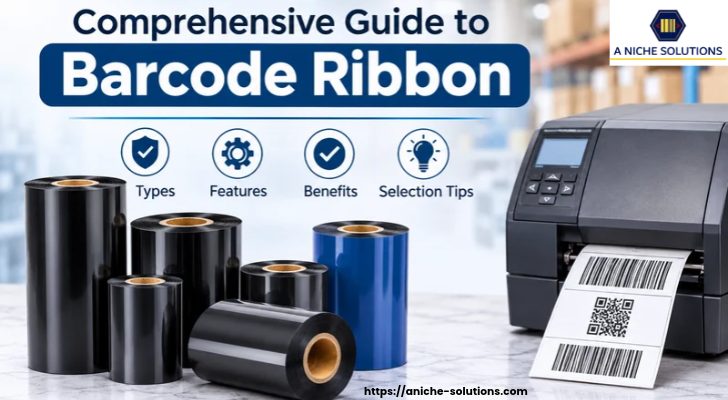
Barcode ribbons play an important role in printing clear, readable, and long-lasting barcode labels. They are commonly used with thermal transfer printers to print product details, barcodes, batch numbers, and other important information on labels.
A good-quality barcode ribbon helps produce prints that remain clear and easy to scan. It also helps protect printed information from fading, smudging, and scratches during storage, handling, and transportation.
Different printing needs require different types of ribbons. The right barcode printer ribbon depends on the label material, printing requirements, and the environment in which the labels will be used.
In this blog, we will explain how barcode ribbons work, their different types, common applications, and the factors to consider when choosing the right barcode label printer ribbon for your business.
What Is a Barcode Ribbon?
A barcode ribbon is an ink-coated film used in thermal transfer printers to print text, barcodes, numbers, and product details on labels. It transfers ink onto the label with the help of heat from the printer's printhead.
A barcode ribbon consists of a thin polyester film coated with a heat-sensitive ink layer. It comes in a roll and is fitted inside a thermal transfer printer. During printing, the ink coating transfers onto the label, while the used film moves onto the take-up roll.
Unlike direct thermal printing, thermal transfer printing uses a separate ribbon to create the print. This makes it suitable for labels that need to withstand handling, moisture, heat, or other environmental conditions.
Understanding the Working Process of a Barcode Ribbon
The thermal transfer printing process involves a few steps that allow the printer to transfer ink from the ribbon onto the label.
Keep the five numbered steps below this paragraph unchanged.
1. Ribbon Installation: The barcode ribbon is placed inside the thermal transfer printer and positioned between the printhead and the label.
2. Heat Application: When printing starts, the printer's printhead generates heat according to the print data.
3. Ink Transfer: Heat melts the ink coating on the ribbon and transfers it onto the label surface.
4. Image Formation: The ink sticks to the label and forms the required text, barcode, or image.
5. Label Printing: The printed label comes out of the printer, ready for scanning, identification, or product tracking.
Different Types of Barcode Ribbons and Their Features
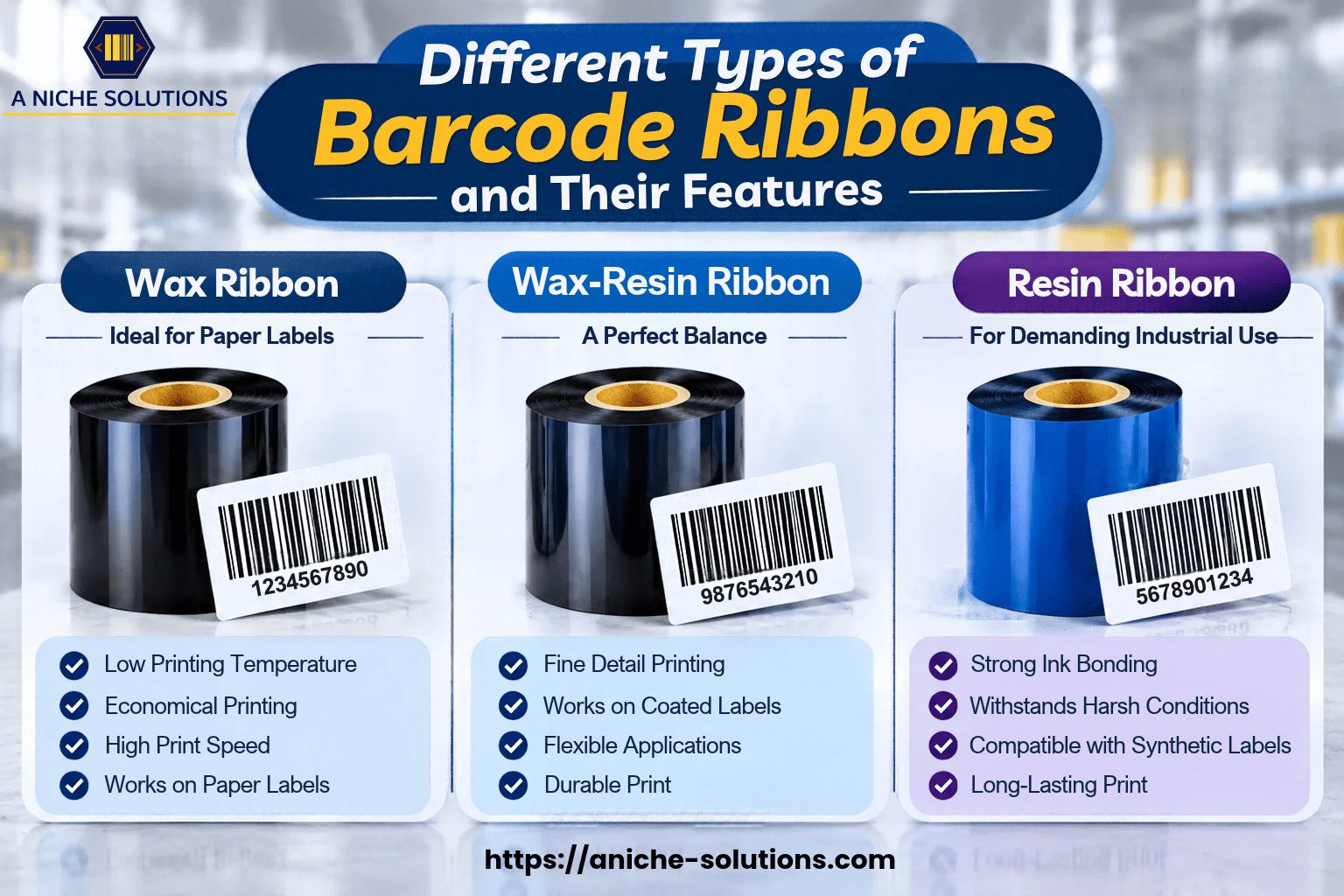
Barcode ribbons are available in three main types: wax, wax-resin, and resin. Each type is made for different printing requirements, label materials, and levels of durability.
1. Wax Barcode Ribbon
Wax ribbons use a wax-based ink coating and are commonly selected for everyday thermal transfer printing.
Wax ribbons are designed mainly for paper-based label printing. Their key features include:
Low Printing Temperature: Requires less heat, which helps reduce printhead wear.
Economical Printing: Suitable for businesses that print large quantities of labels.
High Print Speed: Supports fast printing for routine labelling tasks.
Paper Compatibility: Works well with coated and uncoated paper labels.
2. Wax-Resin Barcode Ribbon
Wax-resin ribbons combine wax and resin to meet printing requirements that need more than standard wax ribbons can offer.
Wax-resin ribbons combine wax and resin to support more demanding label printing applications.
Balanced Ink Composition: Combines the printing properties of wax with the bonding properties of resin.
Fine Detail Printing: Suitable for small text, detailed barcodes, and product information.
Coated Surface Compatibility: Works with coated paper and selected synthetic label materials.
Flexible Applications: Used where standard wax ribbons may not meet printing requirements.
3. Resin Barcode Ribbon
Resin ribbons use a resin-based ink coating and are designed for specialised printing applications involving synthetic label materials.
Resin ribbons are mainly developed for printing on synthetic label materials used in industrial environments.
Strong Ink Bonding: Forms a durable print when used with compatible label surfaces.
Specialised Formulations: Available in different grades for applications requiring resistance to chemicals, heat, or washing.
Synthetic Material Compatibility: Suitable for polyester, polypropylene, and other compatible synthetic labels.
Industrial Printing: Designed for demanding identification and tracking requirements.
Applications of Barcode Ribbons Across Industries
Barcode ribbons are used across different industries to print product information, identification codes, and tracking details on labels. Their ability to print on different label materials makes them useful for many business operations.
Manufacturing Industry
Manufacturing companies use barcode ribbons to print product codes, serial numbers, batch details, and component labels. These labels help identify products during production, storage, and quality checks.
Warehousing and Logistics
Warehouses use barcode ribbons for printing inventory labels, rack identification labels, and shipping details. These labels help workers scan products, track stock movement, and manage dispatch activities.
Retail Industry
Retail businesses use barcode ribbons to print product labels, price tags, and SKU information. These labels help with product identification, billing, and stock management.
Healthcare and Pharmaceuticals
Hospitals, laboratories, and pharmaceutical companies use barcode ribbons to print patient identification labels, medicine labels, sample details, and batch numbers. Clear printing helps reduce identification errors and supports product tracking.
Automotive Industry
Automotive manufacturers use barcode ribbons to print labels for spare parts, electrical components, and finished products. These labels help track components throughout the manufacturing and supply chain process.
Food and Beverage Industry
Food processing and packaging companies use barcode ribbons to print batch numbers, manufacturing dates, expiry dates, and product codes. Resin or suitable wax-resin ribbons can be used with compatible labels where resistance to moisture or handling is required.
How to Choose the Right Barcode Ribbon?
Before purchasing a barcode ribbon, check the following points to make sure it matches your printer and business requirements.
1. Label Material: Check whether you use paper, coated paper, or synthetic labels. Wax ribbons generally work with paper labels, while wax-resin and resin ribbons are suitable for selected coated and synthetic materials.
2. Printing Requirements: Consider the type of information you need to print, such as barcodes, product codes, serial numbers, or small text. The ribbon should provide the required print clarity and detail.
3. Working Environment: Identify whether labels will be used indoors, outdoors, or in specialised environments. This helps determine the type of ribbon and label combination required for the application.
4. Printer Compatibility: Make sure the ribbon matches your thermal transfer printer. Check its width, length, core size, and ink coating position before purchasing.
5. Printing Speed: Check the maximum printing speed supported by your printer and make sure the selected ribbon can maintain consistent print quality at that speed.
6. Budget: Compare the ribbon price with its printing performance and expected usage. A low-cost ribbon may not always be the most suitable option for your application.
What Factors Affect Barcode Ribbon Quality?
The final print quality depends on the ribbon itself, label surface, and printer condition. Several factors can affect how clearly information appears on a printed barcode label.
Ribbon Coating Quality
An uneven ink coating can cause inconsistent ink transfer, resulting in faded areas or missing details on printed labels.
Label Surface
Rough, dusty, or incompatible label surfaces can affect how well the ribbon ink transfers and bonds to the material.
Printer Temperature
Incorrect heat settings can affect ink transfer. Low temperatures may produce light prints, while excessive heat can cause smudging or other printing defects.
Printing Speed
The printer speed must match the ribbon's printing capabilities. An unsuitable speed can affect the consistency of ink transfer.
Printhead Condition
Dust, dirt, or damage on the printhead can affect heat distribution and create uneven prints or blank lines.
Ribbon Storage
Exposure to excessive heat, humidity, and direct sunlight can affect ribbon quality. Proper storage helps maintain its performance before use.
Common Issues Faced When Using Barcode Ribbons
Barcode ribbon printing can sometimes result in errors that affect label quality and scanning. Here are some common problems and ways to resolve them.
Faded or Light Printing
This problem may occur when the printhead temperature is too low or the ribbon does not transfer ink properly. Check the heat settings and ribbon compatibility.
Smudged Printing
Excessive heat, incorrect ribbon selection, or poor label compatibility can cause ink to spread across the label. Adjust the printer settings and check the ribbon type.
Wrinkled Ribbon
Incorrect ribbon alignment or uneven tension can create wrinkles during printing. Make sure the ribbon is properly installed and aligned.
Barcode Not Scanning
Low print contrast, missing lines, or incorrect barcode dimensions can make scanning difficult. Check the print quality and barcode settings.
Ribbon Breaking
Excessive printhead heat, incorrect tension, or poor ribbon quality can cause the ribbon to tear during printing. Use a compatible ribbon and check the printer settings.
Missing Lines in Printing
Dust or dirt on the printhead can create blank lines on printed labels. Clean the printhead regularly and inspect it for damage.
FAQ
1. How long does a barcode ribbon last?
The lifespan depends on the ribbon length, printing volume, label size, and printer settings. A longer ribbon roll can support more printing before replacement.
2. Can one barcode ribbon work with different printers?
Yes, if the ribbon dimensions, core size, coating position, and printer specifications are compatible.
3. Which side of a barcode ribbon faces the label?
The ink-coated side must face the label so that heat from the printhead can transfer the ink onto the label surface.
4 Can barcode ribbons be reused?
No. Once the ink coating has transferred onto the label, the used ribbon cannot provide the same printing quality again.
5. How should barcode ribbons be stored?
Store ribbons in their original packaging in a cool, dry, and dust-free place. Avoid direct sunlight and excessive heat.
Conclusion
Barcode ribbons are an important part of thermal transfer printing. Their type, material, and compatibility with the printer directly affect the quality of printed labels.
Wax, wax-resin, and resin ribbons serve different printing requirements. Businesses should check their label material, printer specifications, and application needs before selecting a ribbon. The right choice helps maintain clear barcode prints and supports accurate product identification.