
A barcode scanner helps businesses identify products, record data, and manage stock quickly. From retail stores and warehouses to hospitals and manufacturing units, barcode scanners make daily work easier and reduce manual data entry errors.
There are different types of barcode scanners, and each one is designed for specific tasks. Some are suitable for billing counters, while others work better for warehouse operations, product tracking, and industrial environments.
The right barcode scanner depends on your business needs, the type of barcodes you use, and your working environment. This guide explains the different types of barcode scanners, their uses, advantages, and limitations to help you choose the right option for your business.
Overview of Barcode Scanners
A barcode scanner is an electronic device that reads information stored in a barcode and sends that data to a connected computer, billing system, or inventory management software. It helps businesses identify products, update stock records, and process transactions without entering product details manually.
Barcode scanners come in different designs, such as handheld, fixed-mount, wireless, and presentation scanners. Some read traditional 1D barcodes, while others can scan 2D barcodes, including QR codes. The right option depends on the scanning speed, barcode type, and work environment.
Modern barcode scanners can connect through USB, Bluetooth, or Wi-Fi, depending on the model. Businesses can also integrate them with POS systems, warehouse management systems (WMS), and enterprise resource planning (ERP) software to maintain accurate records and improve daily operations.
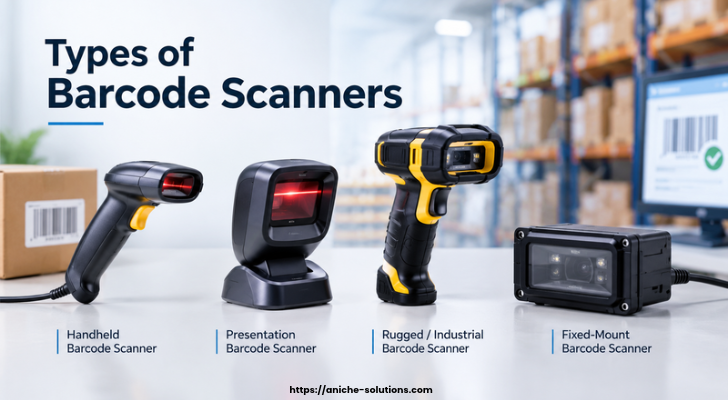
Types of Barcode Scanners Based on Design and Usage
Barcode scanners are available in different designs to support various business operations.Choosing the right type depends on the scanning environment, the volume of items, and the way products move through daily operations.
Handheld Barcode Scanners
Handheld barcode scanners are portable devices that allow users to scan barcodes by pointing the scanner at a product or label. They are commonly used in retail stores, warehouses, inventory management, and shipping departments. These scanners are suitable for businesses that need flexibility when scanning products in different locations.
Presentation Barcode Scanners
Presentation barcode scanners are designed for hands-free scanning. Users can hold or pass products in front of the scanner without needing to press a trigger for every scan.
They are commonly used at supermarket checkouts, retail billing counters, and service desks where multiple products need to be scanned quickly.
Rugged / Industrial Barcode Scanners
Rugged or industrial barcode scanners are built for demanding working environments, including warehouses, manufacturing facilities, and distribution centres. They are designed to withstand tougher conditions, such as dust, frequent handling, and accidental drops, depending on their specifications.
These scanners help workers track inventory, identify products, and scan labels during receiving, picking, packing, and dispatch operations. They are a practical choice for businesses that require reliable scanning in busy industrial settings.
Fixed-Mount Barcode Scanners
Fixed-mount barcode scanners are installed in a fixed position, such as on conveyor belts, production lines, or automated sorting systems. They scan barcodes as products pass through a designated scanning area, reducing the need for manual scanning.
These scanners are widely used in manufacturing, packaging, warehousing, and logistics operations. Depending on the model and system setup, they can support automated product identification, package tracking, and sorting processes.
Selecting the right barcode scanner design helps businesses improve scanning efficiency, reduce manual effort, and maintain accurate product records. Before choosing a scanner, consider the working environment, barcode type, scanning distance, and level of automation required.
Types of Barcode Scanners Based on Technology
Different types of barcode scanners use different technologies to read barcode data. Some are designed for simple product scanning, while others can read QR codes, scan items from a distance, or support fast inventory operations. Understanding these technologies helps businesses choose the right scanner for their daily work.
Laser Barcode Scanners
Laser barcode scanners use a laser beam to read the black lines and white spaces of a barcode. They are commonly used at retail billing counters, supermarkets, and shops where products need to be scanned.
These scanners are mainly designed for 1D barcodes. They are a suitable choice for businesses that need fast and reliable product identification without requiring QR code scanning.
CCD Barcode Scanners
CCD (Charge-Coupled Device) barcode scanners use light sensors to capture barcode patterns and convert them into readable data. They do not use a laser beam and generally work best when the barcode is held close to the scanner.
These scanners are useful in retail stores, libraries, offices, and small inventory operations. They offer reliable performance for short-range scanning of clear, well-printed barcodes.
2D Area Imager Barcode Scanners
2D area imager scanners capture an image of a barcode and process it to read the encoded information. They can scan both 1D and 2D barcodes, including QR codes and Data Matrix codes.
These scanners are widely suited to warehouses, manufacturing units, healthcare facilities, and logistics operations. Depending on the model, they can also read barcodes from mobile screens and handle certain damaged or poorly printed labels.
Camera-Based Barcode Scanners
Camera-based barcode scanners use digital cameras and scanning software to identify barcode information. They are commonly found in smartphones, tablets, and mobile computers used for business operations.
These scanners are useful for stock counting, product identification, and mobile inventory management. Their performance depends on camera quality, lighting, barcode condition, and the software being used.
Key Advantages and Disadvantages of Barcode Scanners
Barcode scanners help businesses manage products, track inventory, and process transactions with less manual effort. Still, businesses should consider their limitations before selecting a scanning solution.
Advantages of Barcode Scanners
Faster Data Entry: Barcode scanners capture product information in seconds, reducing the time required for manual entry.
Better Inventory Accuracy: Scanning products during receiving, picking, and dispatch helps reduce stock recording errors.
Improved Productivity: Employees can process more products and orders in less time, especially during busy periods.
Reduced Operating Costs: Automated data capture reduces repetitive manual work and helps prevent costly data entry mistakes.
Easy System Integration: Many barcode scanners connect with POS systems, inventory management software, and warehouse management systems (WMS).
Better Product Tracking: Businesses can record product movement across storage areas, warehouses, retail stores, and distribution centres.
Disadvantages of Barcode Scanners
Barcode Quality Issues: Damaged, faded, or poorly printed barcodes may be difficult to scan.
Line-of-Sight Requirements: Some scanners need a clear view of the barcode, and items may need to be repositioned before scanning.
Equipment and Maintenance Costs: Businesses need to invest in scanners, barcode labels, software integration, and maintenance.
Limited Data Capacity: Traditional 1D barcodes store less information than many 2D barcodes, so the barcode type must match the business requirement.
Dependence on Supporting Systems: Scanning alone does not guarantee accurate inventory records. Correct product data, software configuration, and employee training are also important.
1D vs. 2D vs. QR Code Scanners: Key Differences
Different barcode scanners support different barcode formats and business needs. The table below compares 1D, 2D, and QR code scanners based on their features, data capacity, and common uses.
The Working Process of a Barcode Scanner
A barcode scanner reads the pattern printed on a product label and converts it into digital data. The information is sent to a connected computer, POS system, or inventory management software, where it is used to identify products and update records.
How Does a Barcode Scanner Work?
Barcode Detection: The scanner detects the barcode when it is placed within its scanning range.
Light or Image Capture: Depending on the technology, the scanner uses a laser, light sensors, or an image sensor to read the barcode pattern.
Data Decoding: The scanner converts the captured pattern into readable information, such as a product code or identification number.
Data Transfer: The decoded information is sent to a connected computer, mobile device, or business system through USB, Bluetooth, Wi-Fi, or another supported connection
Data Processing: The connected software matches the scanned code with the relevant product record and performs an action, such as displaying the price, updating stock, or recording a shipment.
Barcode Scanner Applications Across Various Industries
Barcode scanners are used across many industries to identify products, track inventory, and manage daily operations. They help businesses reduce manual data entry, improve accuracy, and process items faster.
Retail and Supermarkets
Retail stores use barcode scanners at billing counters to identify products and calculate prices quickly. They also help staff check stock levels, manage product returns, and update inventory after sales.
Warehousing and Logistics
Warehouses use barcode scanners to record incoming stock, locate products, verify picked items, and confirm shipments before dispatch. Integration with warehouse management systems (WMS) helps businesses maintain accurate inventory records and process orders efficiently.
Manufacturing
Manufacturing units use barcode scanners to track raw materials, work-in-progress items, and finished products. Scanning at different production stages helps teams maintain traceability, monitor material movement, and reduce identification errors.
Healthcare and Hospitals
Hospitals and healthcare facilities use barcode scanners to identify medicines, track medical supplies, and verify patient information. Barcode scanning also supports medication checks and specimen identification when integrated with suitable healthcare systems.
Banking and Financial Services
Banks and financial institutions use barcode scanning for document tracking, cheque processing, payment-related workflows, and asset identification. The exact applications depend on the barcode format and the systems used by the institution.
Education and Libraries
Schools, colleges, and libraries use barcode scanners to manage books, student records, equipment, and other resources. Staff can scan barcodes to issue or return books, maintain asset records, and complete inventory checks with less manual work.
How to Choose the Best Barcode Scanner for Your Business
The best barcode scanner for your business depends on your daily operations and working environment. Retail stores may need scanners for billing, while warehouses require devices for inventory tracking, order picking, and dispatch. You should also check barcode compatibility. A 1D scanner reads traditional linear barcodes, while a 2D scanner can read both 1D and 2D barcodes, including QR codes.
Scanning speed, reading distance, and connectivity are also important factors. USB scanners are suitable for fixed workstations, while Bluetooth and Wi-Fi models offer more flexibility for mobile operations. Make sure the scanner works with your existing POS, ERP, inventory management, or warehouse management system to transfer data accurately and maintain updated records.
Your working environment and budget should also guide your choice. Warehouses and manufacturing units may require rugged devices with protection against drops, dust, and moisture. Compare the purchase price, maintenance costs, warranty, and expected usage before making a decision. The right barcode scanner should meet your business needs, work smoothly with your existing software, and support future growth.
FAQ
1. Which barcode scanner is best for warehouse use?
A rugged handheld 2D barcode scanner is a suitable choice for many warehouses because it can read different barcode formats and support inventory tracking, order picking, and dispatch operations.
2. Can barcode scanners read QR codes?
Yes, compatible 2D barcode scanners can read QR codes. Traditional laser scanners designed for 1D barcodes generally cannot read them.
3. Are wireless barcode scanners better than wired scanners?
Wireless scanners offer greater mobility for warehouse and inventory tasks, while wired scanners are often suitable for fixed workstations and billing counters. The best option depends on your business requirements.
4. Can barcode scanners work with inventory management software?
Yes, compatible barcode scanners can connect with inventory management systems, POS software, ERP platforms, and warehouse management systems to record product movements and update stock information.
Conclusion
Different types of barcode scanners serve different business needs, from retail billing and inventory tracking to warehouse management and manufacturing. Laser scanners, CCD scanners, and 2D imagers each offer specific features, so the right choice depends on the barcode format, scanning requirements, and working environment.
A suitable barcode scanner helps businesses reduce manual data entry, improve inventory accuracy, and process products faster. Before making a decision, consider scanning speed, connectivity, software compatibility, durability, and budget. The right scanning solution can support smoother daily operations and help your business manage products more efficiently