

Warehouses are no longer just large spaces where goods are stored until they are needed. Businesses today need faster order processing, better inventory control, accurate stock information, and smooth movement of goods.
A modern warehouse uses the right combination of technology, smart processes, trained staff, and organized storage systems to meet these needs. It helps businesses handle growing order volumes while keeping daily warehouse operations under control.
As customer expectations continue to grow, businesses are moving from traditional storage methods to more efficient warehouse practices. Modern warehousing helps reduce manual work, improve accuracy, and make better use of available space.
In this blog, we will look at the key features, technologies, methods, and trends that are shaping modern warehouse operations. We will also compare traditional and modern warehousing to understand why businesses are making this shift.
What is a Modern Warehouse?
A modern warehouse is a storage facility that uses smart processes, technology, and organized workflows to manage goods more efficiently. It goes beyond simply storing products and focuses on how goods are received, stored, picked, packed, and moved.
Modern warehouses use tools such as warehouse management systems, barcode scanners, RFID, automated equipment, and real-time inventory tracking. These tools help warehouse teams keep accurate stock records and reduce manual errors.
The main goal of a modern warehouse is to make daily operations faster, more accurate, and easier to manage. It also helps businesses use storage space properly and respond quickly to changing customer and order demands.
Unlike traditional warehouses, modern facilities are designed around visibility, automation, data, and efficient workflows. This makes them better suited for businesses that handle large product volumes or need faster order fulfilment.
Important Features of a Modern Warehouse
A modern warehouse uses a mix of smart processes and technology to keep storage and warehouse activities organized. The focus is on improving accuracy, saving time, and making daily operations easier to manage.
1. Real-Time Inventory Tracking
A modern warehouse provides clear information about available stock and product movement. Teams can check inventory levels and locations in real time, which helps reduce stock errors.
2. Smart Storage Management
Products are stored based on factors such as demand, size, and movement frequency. This helps businesses use warehouse space properly and reduces unnecessary movement.
3. Faster Order Fulfillment
Organized picking, packing, and dispatch processes help warehouse teams process orders faster. Clear workflows also reduce delays and mistakes during order fulfillment.
4. Automation and Digital Tools
Barcode scanners, RFID, automated equipment, and warehouse software reduce repetitive manual work. These tools help teams complete routine tasks with better speed and accuracy.
5. Centralized Warehouse Management
A warehouse management system (WMS) brings key activities such as receiving, inventory, picking, packing, and dispatch into one system. Managers get better visibility of warehouse operations and can make informed decisions.
What Role Does Technology Play in Modern Warehousing?
Technology plays an important role in modern warehouse operations. It helps businesses manage inventory, track goods, process orders, and monitor warehouse activities with less manual work. This makes daily operations more organized and easier to manage.
A connected warehouse system gives managers real-time information about stock levels, product locations, incoming goods, and outgoing orders. Staff can quickly check where products are stored and track their movement through different stages of the warehouse.
Technology also helps reduce common problems such as incorrect stock records, misplaced products, picking errors, and order delays. Barcode scanners, RFID systems, and warehouse software make it easier to record product movements accurately.
Warehouse technology also supports better decision-making. Managers can use data related to inventory, orders, storage space, and warehouse performance to identify problems and improve daily operations.
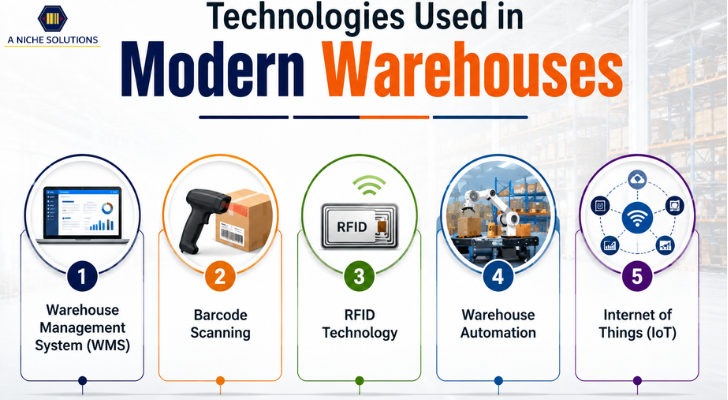
Key Technologies Used in Modern Warehouses
A modern warehouse depends on different technologies to manage stock, track products, and keep daily operations running smoothly.
1. Warehouse Management System (WMS)
A Warehouse Management System (WMS) is one of the main technologies used in modern warehouses. It helps manage activities such as receiving, putaway, inventory tracking, picking, packing, and dispatch from one system. A WMS also provides real-time information about stock levels and product locations.
2. Barcode Scanning
Barcode technology is a simple and widely used solution for tracking products inside a warehouse. Each product or package can have a unique barcode that warehouse staff scan during different stages of its movement. Scanning helps reduce manual data entry and keeps inventory records more accurate. It can also speed up receiving, picking, packing, and dispatch processes by giving staff quick access to product information.
3. RFID Technology
RFID uses small tags and radio signals to identify and track products, packages, or assets. Unlike traditional barcode scanning, RFID does not always require the tag to be directly visible to the reader.
This can make it easier to track multiple items and monitor their movement through the warehouse. RFID is useful for businesses that handle large volumes of products and need better visibility of inventory movement.
4. Warehouse Automation
Warehouse automation uses machines and automated systems to perform repetitive tasks. Conveyors, automated storage and retrieval systems, sorting equipment, and robotic solutions can help move and organize goods.
Automation can reduce the amount of manual work required for routine activities. It also helps maintain consistent workflows and can support faster order processing when warehouse volumes increase.
5. Internet of Things (IoT)
IoT connects devices, equipment, and sensors so they can collect and share data. In a warehouse, IoT can be used to monitor equipment, track assets, check storage conditions, and collect operational information.
The data collected through IoT can help warehouse managers identify equipment problems, monitor important conditions, and understand how different areas of the warehouse are performing. This supports better control over day-to-day operations.
Latest Trends in Warehouse Management
Warehouse management is changing as businesses look for faster, more accurate, and flexible ways to handle goods. New technologies and working methods are helping warehouses manage higher order volumes while keeping operations under control.
1. Warehouse Automation
Automation is becoming more common in warehouses for tasks such as sorting, picking, packing, and moving goods. Automated systems can reduce repetitive manual work and help teams process orders more quickly.
2. AI and Data Analytics
AI and data analytics help warehouse managers understand inventory levels, order patterns, and operational performance. Businesses can use this information to plan stock levels, identify delays, and make better decisions.
3. Cloud-Based Warehouse Management
Cloud-based warehouse management systems allow teams to access warehouse information from different locations. Data is stored in a central system, making it easier to manage inventory and operations without depending on local hardware.
4. Real-Time Inventory Visibility
Businesses are giving more importance to real-time inventory tracking. Barcode, RFID, IoT, and WMS technologies help teams know where products are located and how much stock is available at any given time.
5. Robotics in Warehouses
Robots are being used for activities such as moving goods, picking items, and sorting packages. They can work alongside warehouse staff and help reduce physical workload, especially in warehouses handling large order volumes.
6. Sustainable Warehousing
Many businesses are also focusing on reducing waste and energy use in warehouse operations. Better space planning, energy-efficient equipment, reusable packaging, and optimized transportation can help create more sustainable warehouse processes.
Improving Warehouse Operations
Efficient warehouse operations depend on how well people, processes, inventory, and technology work together. A few practical changes can help businesses reduce delays, improve accuracy, and keep daily warehouse activities organized.
1. Organize the Warehouse Layout
A well-planned layout makes it easier for staff to move products between receiving, storage, picking, packing, and dispatch areas. Fast-moving products can be placed closer to picking and dispatch zones to reduce unnecessary movement.
2. Maintain Accurate Inventory Records
Regular stock checks and real-time inventory tracking help keep records accurate. Barcode scanning, RFID, and WMS software can reduce manual errors and give teams better visibility of available stock.
3. Improve Picking and Packing Processes
Clear picking methods and organized packing stations can help staff process orders faster. Products should be easy to locate, while picking instructions should be clear enough to reduce mistakes.
4. Use Warehouse Technology
The right technology can reduce repetitive work and improve coordination between different warehouse activities. A WMS, barcode scanners, RFID, and automation tools can support faster and more accurate operations.
5. Track Warehouse Performance
Businesses should regularly monitor key warehouse metrics such as order accuracy, picking time, inventory accuracy, order processing time, and space utilization. These figures can show where improvements are needed.
6. Train Warehouse Staff
Technology alone cannot improve warehouse operations. Staff should know how to use warehouse systems, follow safety procedures, handle products correctly, and complete their assigned tasks properly. Regular training helps maintain consistent work quality.
Modern Warehousing Methods and Practices
Modern warehousing methods focus on making storage, inventory handling, and order fulfillment more organized. These practices help businesses reduce unnecessary work, use warehouse space properly, and keep goods moving smoothly.
1. Just-in-Time Inventory
Just-in-time inventory keeps stock levels closer to actual demand. Products are received when they are needed instead of keeping large quantities in storage for a long period. This can reduce storage costs and the risk of excess inventory.
2. ABC Inventory Management
ABC analysis groups products based on their value or importance. High-value items receive closer monitoring, while lower-value items can follow simpler control methods. This helps warehouse teams focus their time on the inventory that matters most.
3. Cross-Docking
Cross-docking reduces the need for long-term storage. Products received at the warehouse are sorted and moved directly to the dispatch area for delivery. This method can reduce storage time and speed up the movement of goods.
4. FIFO and FEFO
FIFO means First In, First Out, where older stock is moved before newer stock. FEFO means First Expired, First Out, where products with the nearest expiry date are dispatched first. These methods are especially useful for food, medicines, and other products with limited shelf life.
5. Cycle Counting
Cycle counting involves checking selected inventory items regularly instead of waiting for one large physical stock count. It helps warehouse teams identify differences between physical stock and system records and correct them sooner.
6. Slotting
Slotting means placing products in storage locations based on factors such as demand, size, weight, and picking frequency. Fast-moving products can be kept in easily accessible locations, which helps reduce travel time during picking.
Traditional vs Modern Warehousing: Key Differences
Traditional and modern warehouses both focus on storing and moving goods, but their approaches to managing daily operations differ significantly.
Why Choose a Modern Warehouse for Efficient Storage?
A modern warehouse helps businesses manage storage, inventory, and order processing in a more organized way. Smart storage methods make better use of available space, while clear workflows help staff move products efficiently.
Technology such as WMS, barcode scanning, and RFID gives teams better visibility of stock levels and product locations. It also reduces manual errors, improves inventory accuracy, and helps staff process orders faster.
A modern warehouse can also support business growth by handling higher inventory and order volumes. Better space utilization, faster operations, and reduced manual work can help businesses save time and manage warehouse costs more effectively.
Real-World Applications of Modern Warehousing
Modern warehousing is used across different industries to manage inventory, storage, and order fulfillment more efficiently. Some common applications include:
E-commerce and Online Retail
E-commerce warehouses handle a large number of customer orders every day. WMS, barcode scanning, and automated sorting help teams pick, pack, and dispatch orders faster.
Retail and Manufacturing
Retailers and manufacturers use modern warehouses to manage raw materials, finished products, and store inventory. Real-time stock tracking helps maintain the right inventory levels and reduce stock-related issues.
Pharmaceuticals and Food
These industries need careful control over product expiry dates and storage conditions. Modern warehouse systems help track batches, expiry dates, stock locations, and temperature-sensitive products.
Logistics and Distribution
Logistics companies use modern warehouses to receive, store, sort, and dispatch goods for different customers. Digital systems provide better visibility of inventory and help coordinate warehouse activities.
FAQ
1. How does technology help a modern warehouse?
Technology helps track inventory, manage storage locations, process orders, and monitor warehouse activities. Tools such as WMS, barcode scanning, RFID, and automation reduce manual work and errors.
2. What technologies are commonly used in modern warehouses?
Common technologies include Warehouse Management Systems (WMS), barcode scanners, RFID, IoT devices, automation systems, robotics, and data analytics.
3. How can a modern warehouse reduce operating costs?
Better space utilization, less manual work, fewer inventory errors, and faster order processing can help reduce warehouse operating costs. Businesses can also identify areas where time and resources are being wasted.
4. Can a modern warehouse handle high order volumes?
Yes. Modern warehouses use organized workflows, digital systems, automation, and better inventory control to handle higher order volumes. These methods help businesses manage growth without depending only on additional manual work.
5. How does a modern warehouse improve customer service?
Faster picking, accurate inventory information, and timely order processing can help businesses fulfill customer orders more reliably. This can lead to fewer delays and better delivery performance.
Conclusion
A modern warehouse is more than a place to store products. It brings together smart storage methods, technology, accurate inventory tracking, and organized processes to keep warehouse operations running smoothly.
From WMS and barcode scanning to RFID, automation, and real-time data, modern warehousing gives businesses better control over their inventory and daily activities. These practices can also help reduce errors, save time, and handle growing order volumes.
As customer and business demands continue to change, modern warehouse practices can help businesses build faster, more flexible, and better-organized storage operations.