
Warehouse operations have changed a lot over the last few years. Businesses now need faster deliveries, better inventory control, and fewer mistakes. Managing all these tasks manually is becoming difficult as order volumes continue to grow.
This is where AI in warehouse management is making a real difference. Artificial Intelligence helps warehouses collect data, understand daily operations, and make better decisions without depending only on manual work. It can improve inventory planning, order picking, storage, and workforce management.
The use of AI in warehouse management also helps businesses respond quickly to changes in customer demand. Instead of reacting after a problem happens, AI can predict issues early and suggest the right action.
Today, companies of all sizes are investing in smart warehouse technologies because they want higher productivity, better accuracy, and lower operating costs. As AI continues to improve, it is becoming an important part of modern warehouse management.
What Is AI in Warehouse Management?
AI in warehouse management means using Artificial Intelligence to make warehouse operations faster, smarter, and more accurate. AI studies data from daily activities and helps warehouses make better decisions with less manual effort.
A warehouse performs many tasks every day, such as receiving goods, storing products, managing inventory, picking orders, packing, and shipping. AI supports these activities by identifying patterns, predicting future requirements, and recommending the best action based on available data.
The use of AI in warehouse management is not limited to large companies. Many small and medium-sized businesses are also using AI through modern warehouse management systems and automation tools. This helps them improve efficiency without changing their complete warehouse setup.
AI also works with technologies such as barcode scanners, RFID, sensors, robots, and warehouse management systems (WMS). These technologies collect real-time information, while AI analyses that information and helps warehouses improve inventory movement, order processing, and space utilization.
Instead of replacing warehouse employees, AI helps them work more efficiently. It reduces repetitive tasks, lowers the chances of human error, and allows staff to focus on work that requires decision-making and problem-solving.
Impacts of AI in Warehouse Management
AI is changing warehouse operations by making daily tasks more accurate and efficient. It helps businesses manage inventory, process orders faster, and make better decisions using real-time data. These improvements create a smoother workflow across the warehouse.
Higher Productivity
AI reduces the time spent on repetitive tasks by helping employees work more efficiently. It recommends the best picking routes, assigns tasks based on workload, and supports faster warehouse operations. This allows teams to complete more work in less time.
Better Order Accuracy
Order mistakes can lead to customer complaints and extra costs. AI checks inventory information, supports accurate picking, and helps verify orders before dispatch. This reduces errors and improves the overall order fulfillment process.
Improved Demand Forecasting
AI studies historical sales, seasonal demand, and buying patterns to estimate future inventory needs. Businesses can stock the right products at the right time and reduce the risk of excess inventory or stock shortages.
Faster Order Processing
The use of AI in warehouse management speeds up every stage of order fulfillment. From receiving an order to picking, packing, and shipping, AI helps warehouses complete each task more efficiently while reducing delays.
Greater Warehouse Visibility
AI provides real-time information about inventory, warehouse activities, and order status. Managers can monitor operations from a single dashboard and quickly identify issues before they affect warehouse performance.
Working Process of AI in Warehouse Management
Instead of relying only on manual decisions, AI helps warehouses make faster and more accurate choices based on real-time information. This allows businesses to improve inventory control, speed up order fulfillment, and use warehouse resources more efficiently.
Data Collection
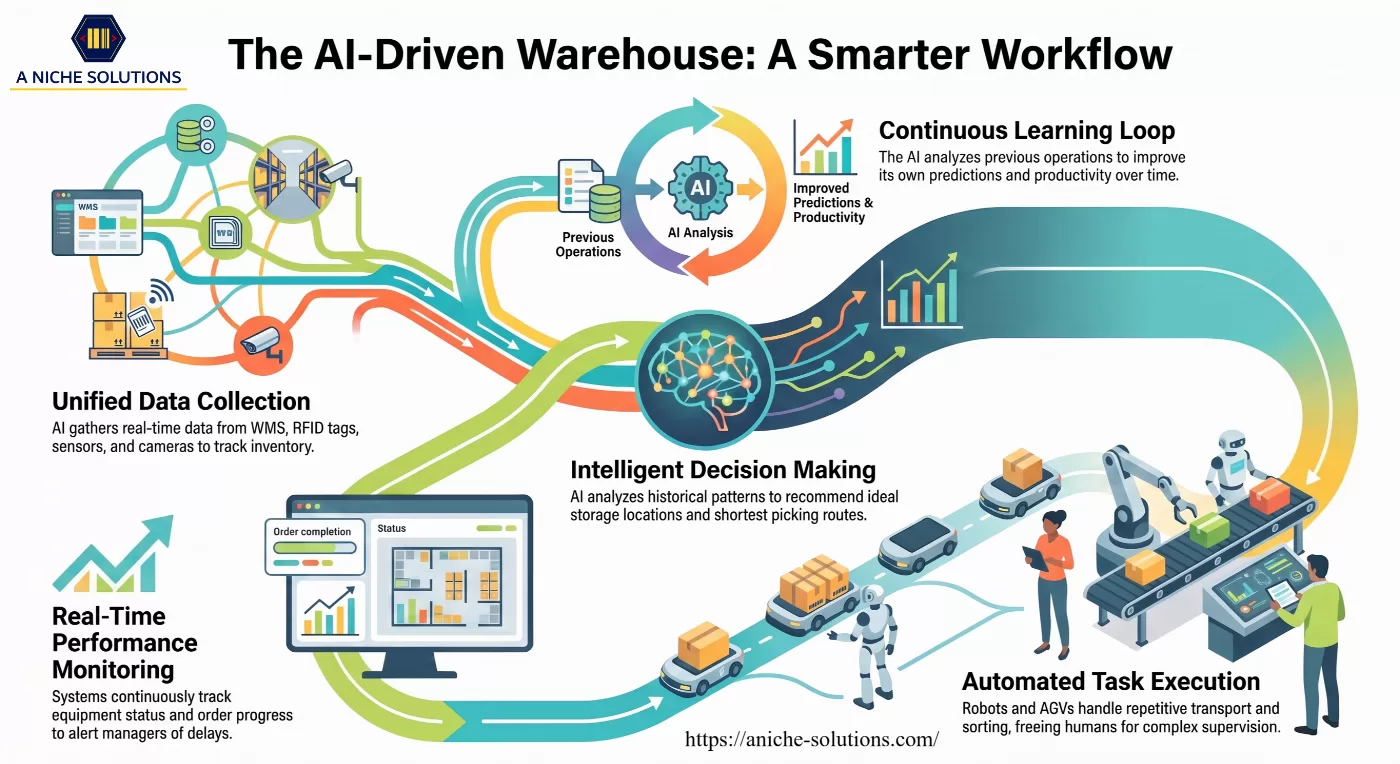
The first step is collecting data from different warehouse systems and devices. AI receives information from warehouse management systems (WMS), barcode scanners, RFID tags, sensors, cameras, and other connected equipment. This data includes inventory levels, product locations, incoming shipments, outgoing orders, and equipment status.
Data Analysis
After collecting the data, AI analyses it to identify patterns and trends. It compares current warehouse activities with historical data to understand how products move, which items are in high demand, and where delays are happening.
This analysis helps businesses identify inventory shortages, slow-moving products, storage issues, and other operational challenges before they become bigger problems.
Decision Making
Once the data has been analysed, AI recommends the best action for different warehouse tasks. It can suggest the ideal storage location for products, prioritize urgent orders, and calculate the shortest picking routes for warehouse staff.
These recommendations help managers make faster decisions while improving overall warehouse efficiency.
Task Automation
AI also supports automated warehouse equipment such as robots, conveyor systems, and Automated Guided Vehicles (AGVs). These systems move products, transport inventory, sort packages, and assist with picking operations.
This reduces repetitive manual work and allows employees to focus on tasks that require human judgment and supervision.
Real-Time Monitoring
AI continuously monitors warehouse operations throughout the day. It tracks inventory movement, order progress, equipment performance, and workforce activities in real time.
If any issue such as low inventory, delayed orders, or equipment downtime is detected, managers receive alerts so they can take immediate action.
Continuous Improvement
One of the biggest strengths of AI is its ability to learn from previous warehouse operations. As more data becomes available, AI improves its predictions and recommendations.
Over time, the use of AI in warehouse management helps businesses achieve better inventory planning, faster order processing, improved warehouse productivity, and more efficient daily operations.
 Challenges of Implementing AI in Warehouse Management
AI offers many advantages, but implementing it is not always simple. Businesses need proper planning, the right technology, and trained employees to get the best results. Understanding these challenges helps companies prepare for a smoother AI adoption process.
High Initial Investment
Setting up AI-powered warehouse systems often requires a significant investment. Businesses may need to purchase new software, automation equipment, sensors, robots, and supporting infrastructure. While the long-term savings can be substantial, the upfront cost can be challenging, especially for small and medium-sized businesses.
Integration with Existing Systems
Many warehouses already use warehouse management systems (WMS), ERP software, and other business applications. Connecting AI with these existing systems can take time and may require system upgrades or technical support to ensure smooth data flow.
Data Quality and Accuracy
AI depends on accurate data to make reliable decisions. If inventory records, product information, or warehouse data are incomplete or incorrect, AI recommendations may also become inaccurate. Businesses need to maintain clean and updated data for better results.
Employee Training
Employees need to understand how AI tools and automated systems work. Proper training helps warehouse staff use the technology confidently and reduces resistance to new ways of working. A well-trained team can make better use of AI in daily operations.
Data Security and Privacy
AI systems process large amounts of business and inventory data. Protecting this information from cyber threats and unauthorized access is important. Businesses should implement strong security measures and regularly update their systems to keep data safe.
System Maintenance
AI systems require regular monitoring, software updates, and maintenance to continue performing efficiently. Businesses should ensure that technical support is available to handle system issues and keep operations running without interruptions.
Future Trends of AI in Warehouse Management
AI is expected to become a standard part of warehouse operations in the coming years. As technology continues to improve, warehouses will rely more on AI to manage inventory, process orders, and support faster decision-making. Businesses are also investing in smart warehouse solutions to meet growing customer expectations while keeping operating costs under control.
The future use of AI in warehouse management will include advanced robotics, predictive inventory planning, and intelligent automation. AI will work with technologies such as IoT sensors, RFID, Automated Guided Vehicles (AGVs), and warehouse management systems (WMS) to create a more connected warehouse environment. Real-time data will help businesses respond quickly to changes in demand, reduce delays, and improve overall warehouse performance.
As AI becomes more affordable and easier to implement, businesses of all sizes will be able to use it in their warehouses. Future AI systems will provide more accurate recommendations, improve inventory visibility, and support better workforce planning. Companies that adopt AI in warehouse management early will be better prepared to handle increasing order volumes, improve customer service, and build a more efficient supply chain.
Key Benefits of AI in Smart Warehouse Management
The benefits of AI in warehouse management go beyond automating daily tasks. AI helps businesses improve inventory control, increase productivity, reduce costs, and make faster business decisions. Here are some of the biggest advantages of using AI in a smart warehouse.
Improved Inventory Accuracy
Maintaining inventory accuracy is one of the biggest challenges for any warehouse. AI continuously monitors stock movement using data from barcode scanners, RFID tags, sensors, and warehouse management systems (WMS). It updates inventory records in real time, making it easier to identify missing items, incorrect stock levels, or misplaced products.
Accurate inventory information helps businesses avoid stock shortages, reduce excess inventory, and fulfil customer orders without unnecessary delays.
Higher Warehouse Productivity
AI helps warehouse teams complete daily tasks more efficiently by reducing unnecessary manual work. It recommends the shortest picking routes, prioritizes urgent orders, and assigns tasks based on workload. This allows employees to spend more time on productive activities instead of searching for products or correcting errors. As a result, warehouses can process more orders in less time while maintaining smooth day-to-day operations.
Faster and More Accurate Order Fulfillment
Order fulfillment includes picking, packing, and shipping products to customers. AI improves each of these steps by organizing workflows and reducing the chances of human error. It helps warehouse staff locate products quickly and ensures that the correct items are packed before dispatch.
Faster order processing leads to shorter delivery times, fewer returns, and a better customer experience, making it one of the major benefits of AI in warehouse management.
Better Decision-Making with Real-Time Data
AI collects and analyses large amounts of warehouse data to provide useful business insights. Managers can monitor inventory levels, warehouse performance, equipment status, and order progress through real-time dashboards.
This helps them identify problems early and make informed decisions without relying on guesswork. With accurate information available at the right time, businesses can improve planning, reduce operational risks, and increase overall warehouse efficiency.
Use Cases of AI in Warehouse Management
The use of AI in warehouse management is growing across different industries, including retail, e-commerce, manufacturing, healthcare, and logistics. Here are some of the most common use cases of AI in warehouses.
Inventory Management
AI monitors inventory levels in real time and keeps stock records updated. It can identify fast-moving and slow-moving products, predict future stock requirements, and alert managers when inventory needs to be replenished. This helps businesses avoid stock shortages and reduce excess inventory.
Order Picking and Packing
AI helps warehouse staff find products quickly by recommending the most efficient picking routes. It also supports automated picking systems and verifies orders before packing, reducing errors and improving order accuracy.
Warehouse Space Optimization
AI analyses product movement and storage patterns to recommend the best storage locations. Frequently ordered products can be placed closer to packing stations, while slow-moving inventory is stored in less accessible areas. This improves warehouse space utilization and reduces travel time.
Demand Forecasting
AI studies historical sales data, seasonal trends, and customer buying patterns to predict future demand. Businesses can use these insights to maintain the right inventory levels and prepare for peak seasons without overstocking.
Workforce Management
AI helps warehouse managers allocate tasks based on employee workload, order priority, and operational requirements. This improves productivity, balances workloads, and ensures that warehouse resources are used efficiently.
Predictive Equipment Maintenance
AI monitors the performance of warehouse equipment such as conveyor belts, forklifts, and automated machines. It can identify signs of wear or potential failures before a breakdown occurs, helping businesses schedule maintenance and reduce unexpected downtime.
FAQ
1. Is AI suitable for small and medium-sized warehouses?
Yes. Many cloud-based Warehouse Management Systems (WMS) now include AI features that are affordable for small and medium-sized businesses. Companies can start with basic AI capabilities and expand as their warehouse operations grow.
2. Does AI replace warehouse workers?
No. AI is designed to support warehouse employees, not replace them. It handles repetitive and data-driven tasks, allowing workers to focus on activities that require human judgment, problem-solving, and supervision.
3. What type of data does AI use in warehouse management?
AI uses data such as inventory levels, order history, product locations, warehouse layouts, equipment performance, employee activities, and customer demand. This information helps AI generate accurate insights and recommendations.
4. Is AI only useful for automated warehouses?
No. AI can also improve manual and semi-automated warehouses. It helps with inventory planning, demand forecasting, route optimization, and operational analysis, even if the warehouse does not use robots or automated equipment.
5. Can AI work with an existing Warehouse Management System (WMS)?
Yes. Most modern AI solutions can integrate with existing Warehouse Management Systems (WMS), ERP software, barcode scanners, RFID systems, and other warehouse technologies. This allows businesses to add AI capabilities without replacing their entire warehouse setup.
Conclusion
AI is changing the way warehouses manage inventory, process orders, and handle daily operations. By using real-time data and intelligent automation, businesses can improve productivity, reduce errors, and make faster decisions.
The use of AI in warehouse management is no longer limited to large enterprises. Businesses of all sizes are adopting AI to build smarter and more efficient warehouses. From inventory management and demand forecasting to order fulfillment and workforce planning, AI supports every stage of warehouse operations.
As technology continues to evolve, the benefits of AI in warehouse management will continue to grow. Companies that invest in AI today can improve operational efficiency, lower costs, and build a warehouse that is ready for future business demands.