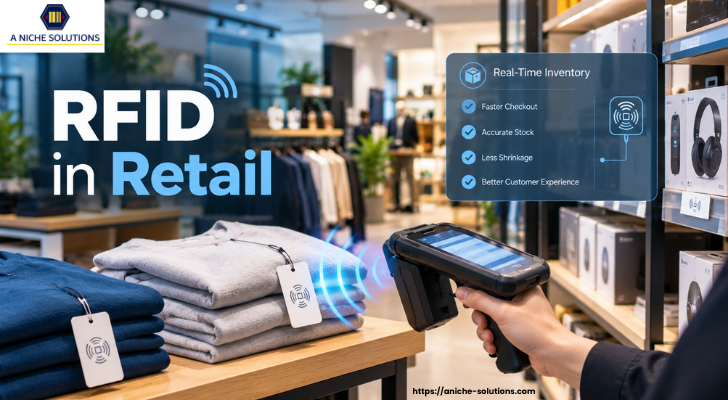
RFID has become an important technology in the retail industry. It helps retailers keep track of products, manage inventory, and reduce errors during daily operations. Unlike traditional methods, RFID can identify multiple items quickly without requiring a direct line of sight.
The use of RFID in retail is growing as businesses look for better stock visibility and faster store operations. From warehouses and stockrooms to retail shelves and checkout areas, RFID technology can support different parts of the retail process.
This guide explains how RFID works in retail, where RFID tags in retail are used, its main benefits, implementation steps, and how RFID compares with barcodes and NFC.
RFID in retail is a technology that uses radio waves to identify and track products. An RFID system mainly uses RFID tags, readers, and software to collect product information and share it with the retailer's system.
An RFID tag is attached to a product, package, or item. The tag stores information such as a product number or item ID. When an RFID reader sends a radio signal, the tag responds with its stored information.
One major advantage of RFID technology in retail is that retailers can read several tags at the same time. The reader does not need to scan each item one by one, which makes stock counting and product tracking faster.
Retailers use RFID to know where products are, how much stock is available, and when items move between different locations. This gives staff better visibility of inventory and helps them manage products more efficiently.
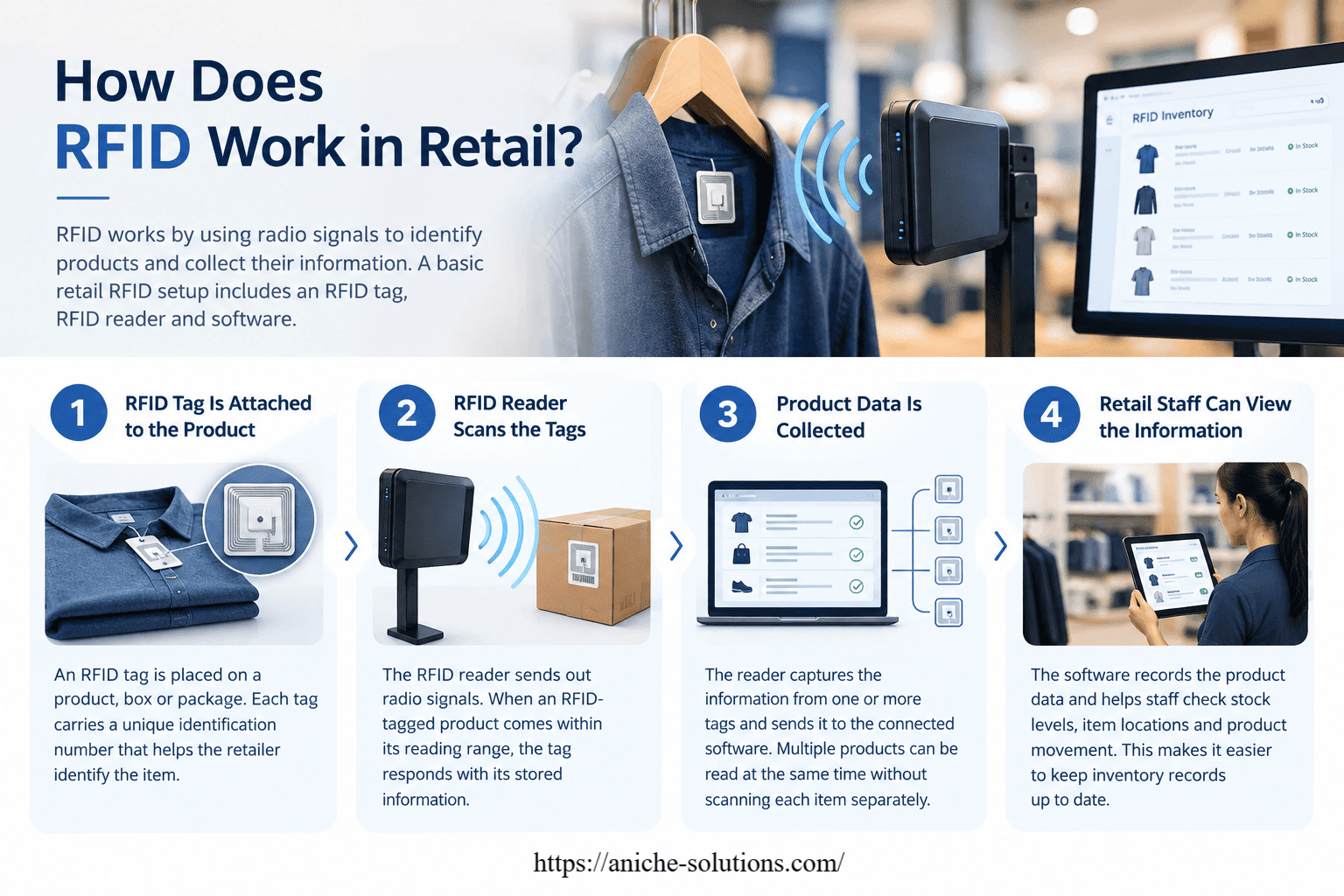
RFID works by using radio signals to identify products and collect their information.
1. RFID Tag Is Attached to the Product: An RFID tag is placed on a product, box, or package. Each tag carries a unique identification number that helps the retailer identify the item.
2. RFID Reader Scans the Tags: The RFID reader sends out radio signals. When an RFID-tagged product comes within its reading range, the tag responds with its stored information.
3. Product Data Is Collected: The reader captures the information from one or more tags and sends it to the connected software. Multiple products can be read at the same time without scanning each item separately.
4. Retail Staff Can View the Information: The software records the product data and helps staff check stock levels, item locations, and product movement. This makes it easier to keep inventory records up to date.
 RFID Applications in Modern Retail
RFID can be used at different stages of retail operations. It helps retailers keep track of products from the time they arrive at the store until they are sold or returned.
RFID can work with an inventory management system to keep stock records updated. Retail staff can quickly check how many products are available, which items are missing, and when stock needs to be replenished.
RFID helps staff locate products stored in stockrooms. Instead of checking shelves or boxes one by one, employees can use RFID readers to identify tagged items and find products faster.
Retailers can use RFID to check whether products are available on shelves. If an item is running low or has been moved to another location, staff can take action before customers find an empty shelf.
When new stock arrives, RFID readers can read several tagged products at the same time. This reduces manual checking and helps staff record incoming products more quickly.
RFID provides information about product movement within the store. Retailers can use this information with their existing security measures to help identify missing products and reduce inventory loss.
RFID can make the return process easier by helping staff identify returned products. They can check the item's tag information against store records before putting it back into available stock.
RFID can simplify several day-to-day retail tasks and give businesses better control over their stock. Here are five key benefits retailers can gain from RFID.
RFID helps retailers keep more accurate stock records by automatically capturing product information. It reduces mistakes that can happen with manual counting and data entry.
RFID readers can identify multiple tagged products at the same time. Staff can complete stock counts faster without checking every item separately.
RFID helps staff identify products that are running low or are not available on shelves. Faster stock replenishment can help retailers keep products available for customers.
RFID reduces the need for repeated manual scanning and data entry. Staff can spend less time on routine inventory tasks and more time handling customers and store operations.
Adding RFID to a retail business requires more than installing readers and attaching tags. A clear plan helps businesses select the right setup and use it effectively.
Start by deciding where RFID is needed most. This could be inventory counting, product tracking, stockroom management, receiving, or another retail process.
RFID tags and readers come in different types and sizes. Select equipment based on the products, reading range, store layout, and operating conditions.
Install RFID readers and antennas at the required locations. Tags should also be placed correctly on products so they can be read consistently.
Connect the RFID setup with the business's existing software and inventory processes. This allows product information collected by RFID to be used for stock tracking and reporting.
Run tests before using RFID across the entire business. Check reading accuracy, tag placement, reader coverage, and data flow to identify any problems.
Employees should know how to use RFID readers and follow the correct process for tagging, scanning, receiving, and tracking products.
Review the system after implementation and track how well it performs. Regular checks can help identify reading issues, process gaps, or areas where RFID can be used more
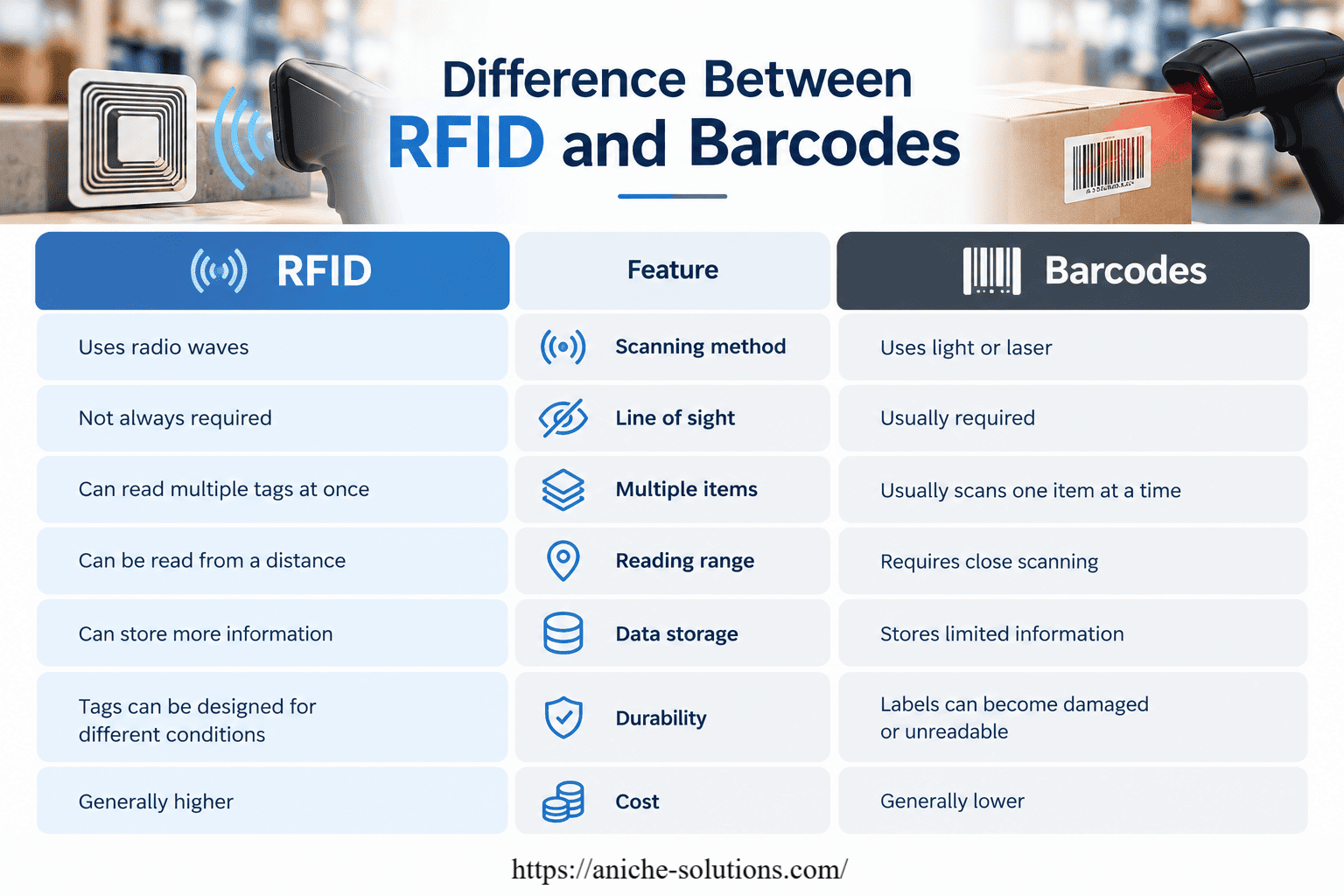
RFID and barcodes both track products differently. In the RFID vs barcode comparison, barcodes require direct scanning, while RFID tags use radio signals to transmit data.
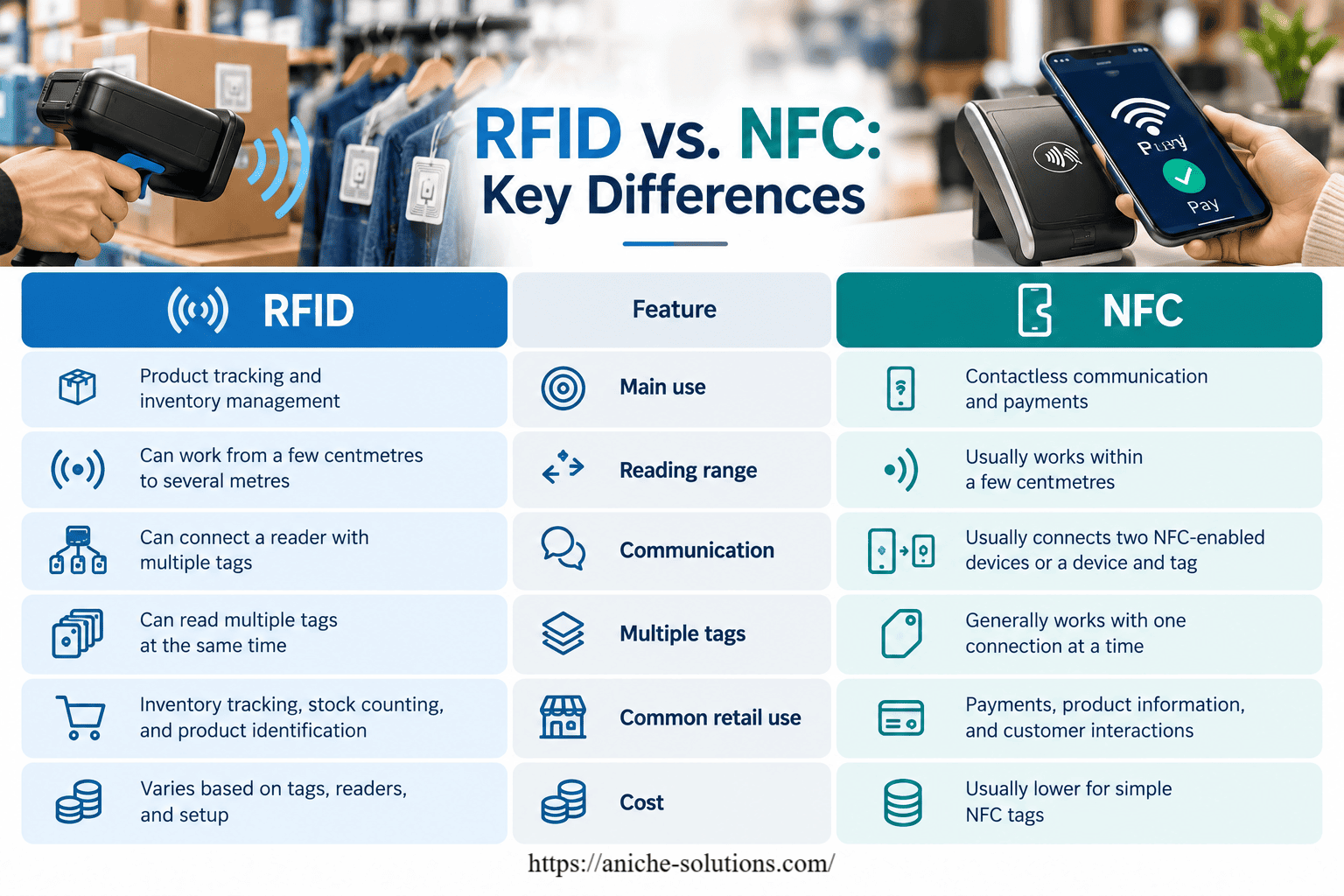
 RFID vs. NFC: Key Differences
RFID and NFC both use radio frequency technology, but differ in range, usage, and communication. This RFID vs. NFC comparison highlights the key differences between the two technologies.
 Why Is RFID Technology Widely Used in Retail?
RFID has become widely used in retail because it helps businesses manage products and inventory with greater speed and accuracy.
One major reason is its ability to read multiple tagged products at the same time. Retail staff can count stock, locate products, and update inventory records without scanning every item individually.
RFID also gives retailers better visibility of product movement. This can help reduce stock errors, improve product availability, and save time on routine inventory tasks.
As retail operations become larger and more complex, RFID provides a practical way to manage products across stores, stockrooms, and warehouses.
A’Niche Solutions provides RFID solutions that help retail businesses manage products, inventory, and daily store operations more efficiently. Its solutions can support businesses that need better stock visibility and faster product tracking.
RFID can be used to track products across warehouses, stockrooms, and retail stores. A’Niche Solutions can help businesses connect RFID technology with their existing systems so product information can be managed from a central platform.
The right RFID setup depends on the business process, product type, store layout, and inventory requirements. A suitable solution can help reduce manual work, improve stock accuracy, and give retail teams better control over product movement.
Some RFID tags are reusable, while others are designed for one-time use. Reusable tags are generally used when products or assets need to be tracked repeatedly.
RFID tags can be affected by physical damage and certain materials or environments. Proper tag selection and placement are important for reliable reading.
RFID can be used with many types of products, but the tag type and placement may need to change based on the product material, size, and packaging.
Yes. RFID can help staff locate products faster and confirm item availability, which can support quicker picking and order fulfilment.
Yes. RFID systems can be deployed across multiple stores and warehouses. Product data can be connected with central business software to provide a wider view of inventory.
RFID has become a useful technology for retailers that need better control over inventory and product movement. It can make stock counting, product tracking, receiving, and other daily tasks faster and more accurate.
The technology can work alongside existing retail systems and can be used in stores, stockrooms, and warehouses. With the right tags, readers, software, and implementation plan, RFID can support smoother retail operations.
For businesses looking to improve inventory visibility and reduce manual work, RFID in retail can be a practical solution for modern retail operations.

At A' Niche Solutions, we transform inventory management into a smart, automated, and future-ready process.
Quick Links
Products
Business Solutions
Gallery
Copyright 2025, A'Niche Infotech Solutions Pvt Ltd. All Right Reserved
Managed By