
Businesses today need faster and more accurate ways to track products, manage inventory, and share information. Two technologies that are commonly used for these tasks are RFID and NFC. While both use radio waves to transfer data without physical contact, they work in different ways and are designed for different purposes.
Many people compare NFC vs RFID because both technologies help automate operations and reduce manual work. You can find RFID in warehouses, retail stores, logistics hubs, and manufacturing units. NFC is commonly used for contactless payments, smartphone interactions, and digital access systems.
Understanding the difference between RFID vs NFC helps businesses choose the right solution based on their needs, budget, and operating environment. This guide explains how RFID and NFC work, their applications, advantages, limitations, and the key differences between them.
What is RFID?
RFID stands for Radio Frequency Identification. It is a technology that uses radio waves to identify, track, and manage objects without requiring direct contact or a clear line of sight. An RFID system mainly consists of three components: an RFID tag, an RFID reader, and software that processes the collected data.
An RFID tag contains a small microchip and an antenna. When the tag comes within the range of an RFID reader, it transmits information stored in the tag. The reader captures this data and sends it to a computer system for tracking and monitoring purposes.
Many industries use RFID to improve inventory management, asset tracking, warehouse operations, logistics, healthcare, and retail processes. Since RFID can read multiple tags at the same time, it helps businesses save time and reduce manual errors.
Unlike barcode systems, RFID tags do not always need to be scanned individually. This makes RFID a practical solution for businesses that handle large volumes of products and assets every day.
Types of RFID Frequency
FID technology operates on different frequency ranges. Each frequency offers different reading distances and performance levels.
Low Frequency (LF RFID) : LF RFID usually operates between 125 kHz and 134 kHz. It provides a short reading range and works well in environments where metal and liquids are present. Animal tracking and access control systems commonly use this frequency.
High Frequency (HF RFID) : HF RFID operates at 13.56 MHz and offers a moderate reading range. Library management, ticketing systems, and product authentication often use HF RFID tags. NFC technology is also based on this frequency range.
Ultra-High Frequency (UHF RFID) : UHF RFID operates between 860 MHz and 960 MHz. It provides longer reading distances and faster data transfer. Warehouses, logistics companies, and retail businesses widely use UHF RFID for inventory tracking and supply chain management.
Applications of RFID
RFID is used across many industries to improve tracking, visibility, and operational efficiency. Its ability to capture data automatically makes it useful for businesses that manage large numbers of products, assets, or people.
Inventory Management : Retail stores and warehouses use RFID tags to track inventory in real time. The data captured through RFID can be integrated with an inventory management system, helping staff quickly identify stock levels, locate products, and reduce inventory errors.
Asset Tracking : Organizations use RFID to monitor valuable equipment, tools, and fixed assets through asset tracking solutions. This helps prevent loss and improves asset utilization.
Supply Chain and Logistics : Logistics companies use RFID to track shipments throughout the supply chain. Real-time visibility helps businesses know the location and status of goods at every stage.
Retail Operations : Many retailers use RFID for faster stock counting, product identification, and theft prevention. Better inventory accuracy also helps improve customer satisfaction.
Healthcare Management : Hospitals use RFID to track medical equipment, medicines, and patient records. Quick access to accurate information supports better operational control.
Access Control and Security : RFID cards and badges are commonly used for employee access management. Authorized users can enter restricted areas without using traditional keys.
Advantages and Disadvantages of RFID
Understanding both the advantages and disadvantages can help organizations make the right decision.
Advantages of RFID
Read multiple tags at the same time.
Does not require direct line-of-sight scanning.
Supports faster inventory and asset tracking.
Reduces manual data entry and human errors.
Works well for large-scale operations.
Provides real-time visibility of products and assets.
Disadvantages of RFID
Initial setup costs can be higher than barcode systems.
Performance may be affected by certain metals and liquids.
RFID infrastructure requires readers, tags, and software.
Some RFID tags can be more expensive than traditional labels.
System implementation may require technical expertise.
What is NFC?
NFC stands for Near Field Communication. It is a short-range wireless communication technology that allows two compatible devices to exchange data when they are placed close to each other. NFC operates at a very short distance, usually a few centimeters, making it secure and easy to use.
Many people interact with NFC every day without realizing it. Contactless payments, digital ticketing, smartphone pairing, and smart access cards are some common examples. NFC technology is built on the same frequency range as High Frequency (HF) RFID, but it is designed for close-range communication between devices.
Compared to RFID, NFC focuses more on secure and convenient interactions. Smartphones, tablets, payment terminals, and smart tags commonly use NFC technology for quick data exchange.
Applications of NFC
NFC is widely used in daily life because it provides a simple way to exchange information and perform secure transactions. Businesses and consumers use NFC across various industries for convenience and efficiency.
Contactless Payments : Mobile payment services use NFC to enable quick and secure transactions. Users can simply tap their smartphone or payment card on a compatible terminal to complete a purchase.
Access Control : Many offices, hotels, and event venues use NFC-enabled cards or smartphones for secure entry. This reduces the need for physical keys and improves access management.
Public Transportation : Transport systems use NFC-based cards and mobile applications for ticket validation and fare collection. Passengers can tap their device and continue their journey without delays.
Smart Product Information : Businesses use NFC tags on products to provide customers with additional information. A simple tap with a smartphone can open product details, user manuals, or promotional content.
Device Pairing : NFC makes it easy to connect compatible devices such as speakers, headphones, and printers. A quick tap can establish a connection without manual setup.
Advantages and Disadvantages of NFC
NFC offers convenience, security, and ease of use for short-range communication. At the same time, its limited operating range may not suit every business requirement.
Advantages of NFC
Easy to use and requires minimal setup.
Supports secure contactless transactions.
Works with many modern smartphones.
Enables fast data sharing between compatible devices.
Suitable for customer engagement and mobile applications.
Disadvantages of NFC
Operates only over a very short distance.
Cannot read multiple tags from long ranges.
Not suitable for large-scale inventory tracking.
Data transfer speed is limited compared to some wireless technologies.
Requires NFC-enabled devices for communication.
RFID vs NFC: Understanding the Key Differences
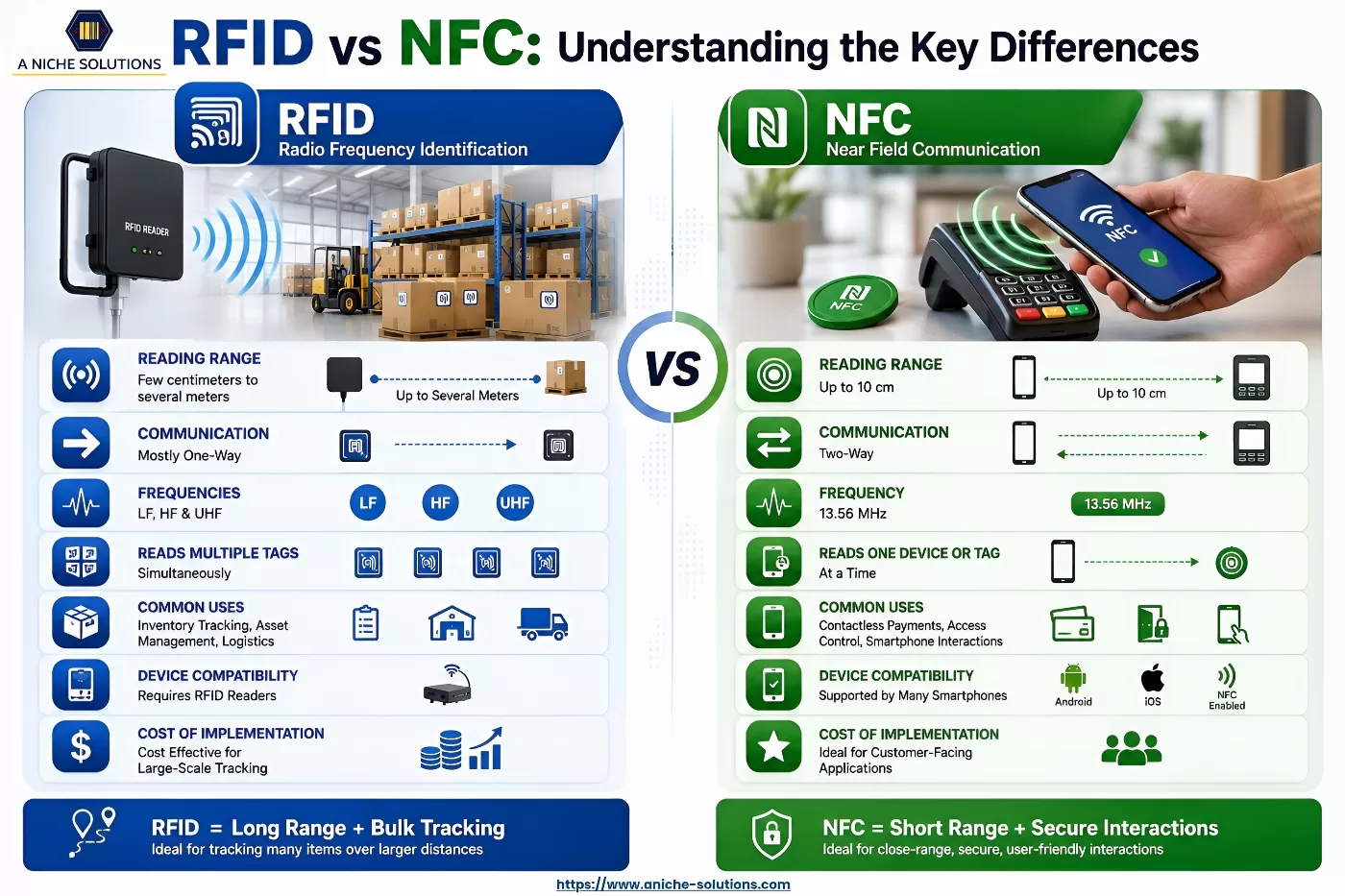
When comparing NFC vs RFID, it is important to understand that both technologies use radio waves to transfer data, but they are designed for different purposes. The following comparison helps explain the major differences between RFID vs NFC technologies.
Reading Distance
One of the biggest differences between NFC and RFID is the reading range. RFID systems can read tags from much greater distances depending on the frequency being used. NFC works only when devices are placed very close to each other.
Communication Method
RFID generally focuses on identifying and tracking tagged items. NFC allows two devices to exchange information, making it suitable for payments, authentication, and data sharing.
Business Applications
RFID is commonly used in warehouses, retail stores, manufacturing facilities, and logistics operations. NFC is more common in mobile payments, smart access systems, digital tickets, and customer engagement programs.
Tag and Reader Requirements
When comparing RFID tags vs NFC tag, RFID tags often require dedicated RFID readers for communication. NFC tags can be read directly by many modern smartphones, making them more convenient for consumer applications.
Data Exchange Capabilities
Another important difference between NFC tags and RFID is communication capability. RFID systems are mainly designed for identification and tracking, while NFC supports interactive communication between devices and tags.
Following is a short table format explanation of the difference between these two technologies.
Which Is the Right Technology for Your Business: NFC or RFID?
The right choice depends on your business objectives, operational needs, and the type of information you want to capture. Both technologies offer unique benefits, but they serve different purposes.
RFID is a better option for organizations that need to track large numbers of products, assets, or shipments. Warehouses, retail chains, manufacturing facilities, and logistics companies often use RFID along with a warehouse management system and transportation management system.
NFC works best for businesses that require secure and convenient interactions with customers or employees. Contactless payments, access control systems, digital business cards, loyalty programs, and smart marketing campaigns commonly rely on NFC technology.
Businesses focused on inventory visibility and asset tracking generally benefit more from RFID. Organizations looking to support mobile interactions, customer engagement, and secure transactions often find NFC more suitable. Some companies use both RFID and NFC to support different business processes and customer experiences.
FAQ
1. Can a smartphone read RFID tags?
Most smartphones can read NFC tags, but they cannot read all RFID tags. Many RFID systems require dedicated RFID readers, especially those operating on UHF frequencies.
2. Can RFID and NFC be used together?
Yes, businesses can use both technologies together. RFID can manage inventory and asset tracking, while NFC can support customer engagement, authentication, and mobile interactions.
3. Why is RFID used in warehouses?
RFID helps warehouses track inventory quickly and accurately. It can read multiple tags at the same time, which reduces manual work and improves inventory visibility.
4. Does NFC require an internet connection?
No, NFC communication does not require an internet connection. Data can be exchanged directly between compatible devices that are within close range.
Conclusion
Both RFID and NFC use radio waves to exchange information, but they are designed for different business needs. RFID is widely used for inventory tracking, asset management, and supply chain operations because it supports longer reading distances and the ability to scan multiple tags at once.
NFC focuses on secure, short-range communication between devices. Contactless payments, access control, digital ticketing, and smartphone interactions are some of its most common uses.
A clear understanding of NFC vs RFID helps businesses select the right technology based on their operational requirements. Companies that need large-scale tracking often prefer RFID, while organizations looking for simple and secure customer interactions may find NFC more suitable. The right solution depends on how the technology will be used and the goals the business wants to achieve.