
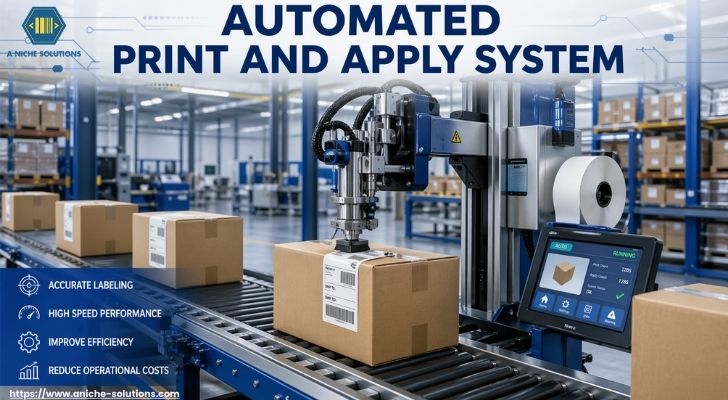
In many industries, speed and accuracy play an important role in packaging and shipping. Businesses handle thousands of products every day, and each item needs the right label before it moves further in the supply chain. Manual labeling takes time and can lead to errors, especially when the volume is high.
An automated print and apply system helps solve this problem. It prints labels and applies them to products or packages without much human effort. This type of system is widely used in warehouses, logistics, manufacturing, and eCommerce operations.
Companies are now shifting towards automated print-and-apply systems to improve their workflow. These systems reduce manual work, save time, and help maintain consistency in labeling. Print and apply automation also supports better tracking, which is important for smooth operations.
In this blog, we will understand how these systems work, where they are used, and how they help businesses in day-to-day operations.
What are Automated Print and Apply Systems?
An automated print and apply system is a machine that prints labels and places them on products, cartons, or pallets automatically. It works without the need for manual sticking of labels, which saves time and reduces mistakes.
This system is a combination of a printer and an applicator. The printer creates the label with details like barcode, product name, shipping address, or batch number. The applicator then places that label on the correct surface with proper alignment.
Print-and-apply systems are used in places where large volumes of products are handled every day. These systems make sure that each package gets the right label at the right position. This is important for tracking, scanning, and delivery.
Print and apply automation also supports different types of labeling needs. It can apply labels on the top, side, or even corners of a package depending on the setup. This flexibility makes it useful for different industries and packaging types.
Working Process of Automated Print and Apply Systems
Here is a detailed process of how an automated print and apply system works in five clear steps:
Step 1: Product Detection and System Trigger
A product or carton moves on the conveyor and reaches the labeling point. Sensors detect the presence of the item and send a signal to the system. This step is important because it tells the machine that a label needs to be printed and applied.
Step 2: Data Input and Label Creation
The system receives data from connected software like WMS or ERP. This data includes details such as barcode, product name, price, or shipping information. Based on this input, the printer quickly generates the required label without any manual effort.
Step 3: Label Printing and Transfer
The printer prints the label in real time. After printing, the label moves forward to the applicator using a controlled mechanism. The system makes sure the label is ready at the right moment so there is no delay in the process.
Step 4: Accurate Label Application
Sensors check the exact position of the product to ensure proper placement. The applicator then places the label on the surface using a suitable method like air blow, tamp, or wipe. This step ensures the label sticks correctly and is aligned properly.
Step 5: Verification and Product Movement
The system checks whether the label has been applied correctly. Some systems use sensors or scanners for this verification. Once confirmed, the product moves ahead on the conveyor for the next stage like packing or dispatch.
Applications of Automated Print and Apply Systems
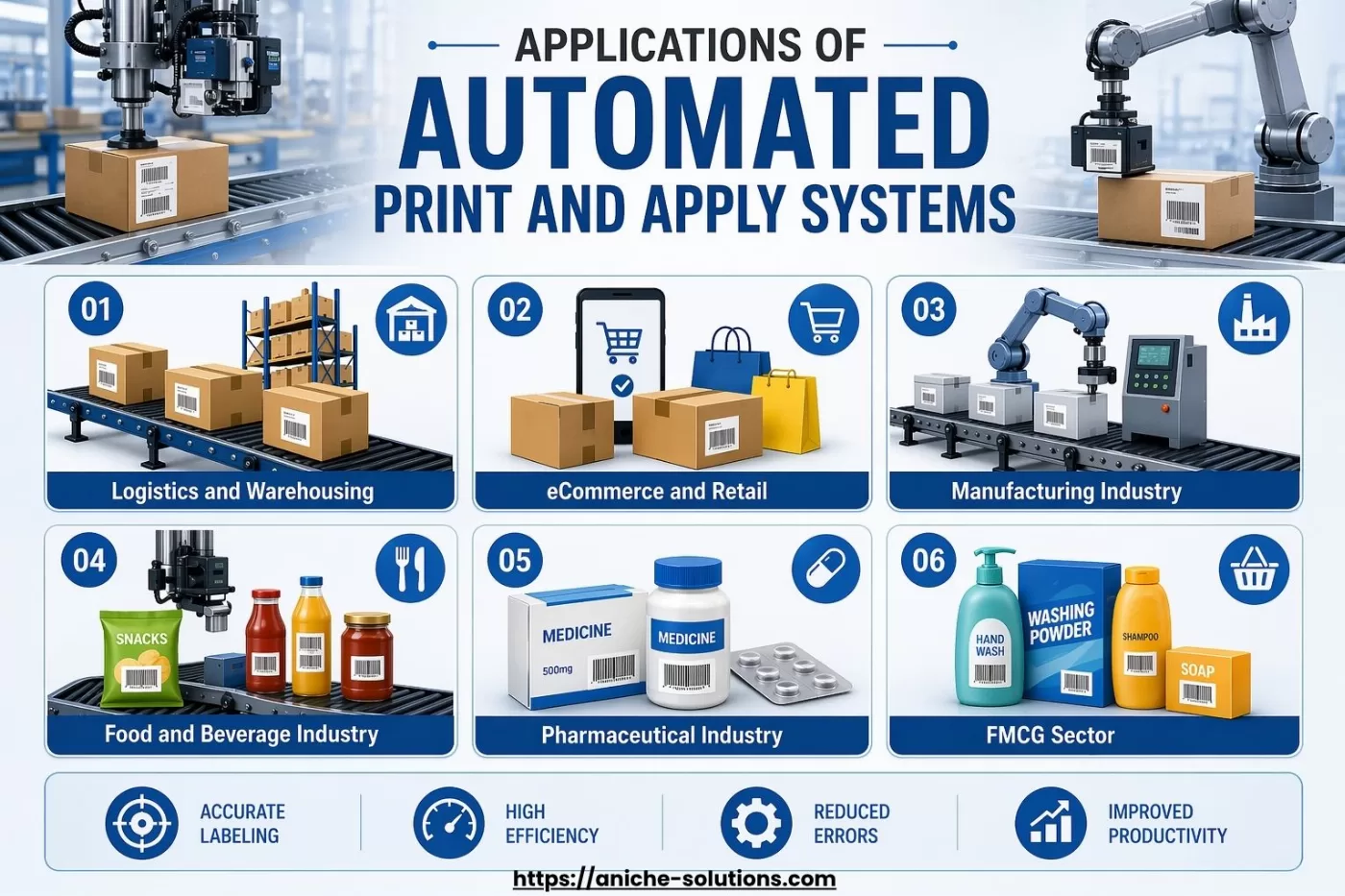
Automated print and apply systems are used in many industries where labeling is an important part of daily operations. These systems help manage large volumes of products with speed and accuracy.
Logistics and Warehousing
Warehouses use automated print and apply systems to label cartons and shipments. Labels include barcodes and shipping details, which help in tracking and smooth movement of goods. This is very useful in high-volume operations.
eCommerce and Retail
Online businesses handle a large number of orders every day. Print and apply automation helps in labeling packages with order details and delivery addresses. This reduces errors and speeds up order processing.
Manufacturing Industry
Manufacturing units use these systems to label products during production. Labels may include batch numbers, product codes, and expiry dates. This helps in maintaining proper records and quality control.
Food and Beverage Industry
Food companies use automated print-and-apply systems to label packaging with important details like ingredients, manufacturing date, and expiry date. Proper labeling is important for safety and compliance.
Pharmaceutical Industry
Pharma companies require accurate labeling for medicines and packaging. These systems help in applying labels with correct information, which is important for safety and regulations.
FMCG Sector
Fast-moving consumer goods companies use these systems for labeling products at high speed. It helps in maintaining consistency and handling bulk production without delays.
Key Benefits of Automated Print and Apply Systems
Here are four main benefits of using an automated print and apply system, explained in detail:
1. Faster and Smooth Operations
An automated print and apply system works much faster than manual labeling. It prints and applies labels in seconds without stopping the production line. This helps businesses handle large volumes of products every day. A smooth flow of labeling also reduces delays in packing and shipping, which improves overall efficiency.
2. High Accuracy and Fewer Errors
Manual work often leads to mistakes like wrong labels or incorrect placement. Print and apply automation reduces these errors by following a fixed process. The system uses data directly from software, so the chances of human error are very low. Correct labeling is important for tracking, delivery, and customer satisfaction.
3. Lower Labor Dependency
Manual labeling needs workers to print, check, and apply labels one by one. This takes time and effort. Automated print-and-apply systems reduce this dependency on manual work. Businesses can use their workforce for other important tasks instead of repetitive labeling work.
4. Consistent Label Quality and Placement
Every product needs a label in the right position for easy scanning and identification. These systems make sure that each label is placed correctly in the same spot every time. This consistency improves barcode scanning and gives a clean and professional look to packaging.
How A' Niche Solutions Print and Apply System Helps Businesses
A' Niche Solutions provides automated print and apply systems that help businesses manage labeling in a faster and more organized way. These systems connect easily with software like WMS and ERP, so label data is sent directly to the machine. This reduces manual work and helps avoid common errors during the labeling process.
The system is designed to handle different types of packaging such as cartons, boxes, and pallets. It ensures that each label is printed clearly and placed in the correct position every time. This improves barcode scanning and helps in smooth tracking of products across the supply chain.
A' Niche Solutions also focuses on ease of use and reliable performance. The system is simple to operate, which means less training is required for staff. With print and apply automation, businesses can improve speed, maintain accuracy, and handle high-volume operations without delays.
FAQ
1. Can these systems handle different types of packaging?
Yes, automated print and apply systems can work with cartons, boxes, and pallets. They can also apply labels on different surfaces like top, side, or corner.
2. Is it difficult to operate these systems?
No, most systems are user-friendly. Staff can learn to operate them with basic training, and the process becomes easy once set up.
3. What types of labels can be used in these systems?
These systems can use different types of labels such as barcode labels, shipping labels, product labels, and compliance labels. The choice depends on the business requirement.
4. Can automated print and apply systems be customized?
Yes, these systems can be adjusted based on business needs. Settings like label size, placement position, and application method can be customized for different products.
5. Does print and apply automation support high-speed operations?
Yes, these systems are designed for high-speed environments. They can print and apply labels quickly without slowing down the production or packaging line.
Conclusion
Automated print and apply systems have become an important part of modern packaging and labeling processes. They help businesses manage large volumes of products with better speed and accuracy. Manual labeling often leads to delays and errors, while print and apply automation makes the process smooth and reliable.
These systems are useful across different industries, from logistics to manufacturing. They support proper labeling, which is important for tracking, delivery, and compliance. Consistent label placement also improves scanning and reduces operational issues.
Businesses that invest in automated print-and-apply systems can reduce manual work, improve efficiency, and handle growing demand more easily. A well-set system helps maintain control over labeling and supports better day-to-day operations.