
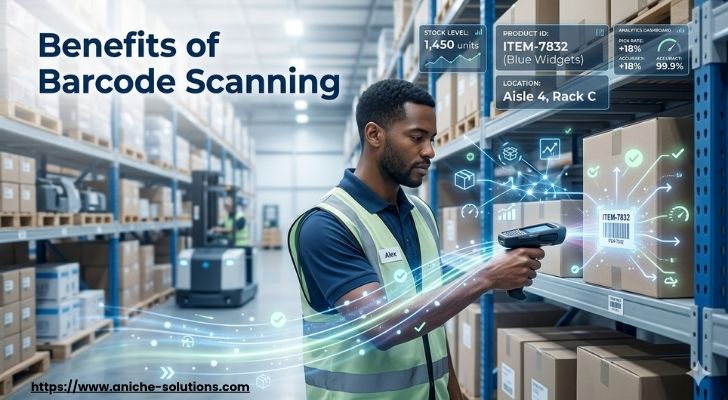
Barcode scanning plays an important role in modern business operations. Many companies use it to manage products, track inventory, and reduce manual work. From small shops to large warehouses, barcode systems help in handling daily tasks in a faster and more accurate way.
Manual data entry often leads to mistakes and takes more time. Barcode scanning solves this problem by capturing data instantly with a simple scan. It helps businesses save time, reduce errors, and improve overall efficiency.
As operations grow, handling inventory and tracking products becomes more complex. Barcode scanning makes this process simple and organized. It supports better decision-making by providing accurate and real-time information.
What is Barcode Scanning?
Barcode scanning is a method used to read and collect information from a barcode using a scanner. A barcode is a series of lines or patterns that stores product details like price, item code, or batch number.
A barcode scanner reads this pattern and converts it into digital data. This data is then sent to a computer or software system for processing. The whole process takes just a few seconds and removes the need for manual entry.
Businesses use barcode scanning in many areas such as retail stores, warehouses, logistics, and manufacturing. It helps in tracking products, managing stock, and speeding up billing processes.
There are different types of barcode scanners like handheld scanners, fixed scanners, and mobile scanning devices. Each type is used based on the business need and working environment.
10 Important Benefits of Barcode Scanning
Barcode scanning helps businesses handle daily operations in a smooth and organized way. Below are the key benefits explained in detail:
1. Faster Data Entry
Barcode scanning captures product information in seconds. Staff only need to scan the code instead of typing details manually. This speeds up tasks like billing, stock entry, and order processing. Work gets done faster, even during busy hours.
2. Better Accuracy
Manual entry often leads to typing mistakes, wrong numbers, or missing details. Barcode scanners read data exactly as it is stored in the code. This reduces errors and keeps records accurate. Correct data also helps in better planning and reporting.
3. Real-Time Inventory Tracking
Businesses can check stock levels at any time with barcode scanning. Every scan updates the system instantly. It becomes easy to know how many items are available, sold, or moved. This helps in avoiding both overstock and stock shortages.
4. Improved Productivity
Employees spend less time on manual work. Scanning products is quick and simple, so tasks like picking, packing, and stock checking get completed faster. Teams can handle more work in less time without extra effort.
5. Easy Inventory Management
Barcode systems keep all product details in one place. Each item has a unique code, which makes it easy to identify and track. Businesses can manage large inventories without confusion. Stock counting and audits also become easier.
6. Cost Savings
Errors in stock or billing can lead to losses. Barcode scanning reduces these mistakes and saves money. It also lowers the need for extra staff since work becomes faster and more efficient. Over time, this helps in controlling operational costs.
7. Better Customer Service
Customers expect quick and accurate service. Barcode scanning speeds up billing at checkout and reduces waiting time. It also ensures correct product information, which builds trust and improves the overall shopping experience.
8. Simple Product Tracking
Each product can be tracked from the time it enters the system until it is delivered. Businesses can monitor movement across warehouses, stores, or delivery routes. This helps in reducing lost or misplaced items.
9. Easy Integration with Systems
Barcode scanning works well with inventory management systems and ERP systems. Data from scanners gets updated automatically in the system. This creates a smooth flow of information between departments like sales, warehouse, and accounts.
10. Supports Business Growth
As business operations increase, managing products manually becomes difficult. Barcode scanning makes it easier to handle larger volumes without confusion. It supports expansion by keeping processes organized and scalable.
How Barcode Scanning Work in Warehouses
Barcode scanning follows a clear process in warehouses. Each step helps in tracking products and keeping inventory accurate.
Step 1: Receiving Goods
When products arrive at the warehouse, staff scan the barcode on each item. If a product does not have a barcode, a new one is created and attached. The system records details like product name, quantity, and batch.
Step 2: Recording in the System
After scanning, all product data gets stored in the inventory system. This creates a proper record of incoming stock. It helps in keeping track of every item from the beginning.
Step 3: Assigning Storage Location
Each product is placed in a specific location such as a rack, shelf, or bin. These locations may also have barcodes. Staff scan both the product and location code to link them in the system.
Step 4: Storing the Products
Products are stored in their assigned places. Since the system already has location data, staff can easily find items later without confusion.
Step 5: Order Picking
When an order is received, staff get a picking list. They scan items while collecting them from storage. This ensures the correct product and quantity are picked.
Step 6: Packing the Items
Before packing, products are scanned again. This step checks if all items match the order details. It helps in avoiding wrong shipments.
Step 7: Shipping and Dispatch
Once packing is complete, items are scanned during dispatch. The system updates stock automatically and records that the product has been shipped.
Step 8: Inventory Checking (Stock Audit)
Warehouse staff use barcode scanners during stock checks. Instead of manual counting, they scan items to verify stock levels. This saves time and keeps records accurate.
Common Use Cases of Barcode Scanning
Barcode scanning is used across different industries to manage products, track movement, and reduce manual work. Below are detailed use cases:
Retail Stores
Retail stores use barcode scanning mainly at billing counters. Staff scan each product to generate the bill quickly and accurately. It removes the need to enter prices manually, which reduces errors.
Barcode scanning also helps store owners track stock levels. They can see which products are selling fast and which are not. This makes it easier to plan restocking and avoid running out of popular items.
Warehousing
Warehouses use barcode scanning in almost every activity. From receiving goods to shipping orders, scanning helps track each step.
When items arrive, they are scanned and recorded in the system. While storing, picking, and packing, staff scan products to make sure the right items are handled. This reduces confusion and keeps inventory data accurate.
Logistics and Shipping
Logistics companies use barcode scanning to track shipments at every stage. Each package has a barcode that gets scanned during pickup, transit, and delivery.
This process provides real-time updates about the shipment. Businesses and customers can check the status of their orders easily. It also reduces the chances of lost or misplaced packages.
Inventory Management
Barcode scanning makes inventory management simple and reliable. Every product has a unique code, which helps in identifying and tracking it.
Stock levels get updated automatically after each scan. Businesses can check available quantities at any time. This helps in avoiding overstocking and stock shortages.
Healthcare Industry
Hospitals and medical stores use barcode scanning to manage medicines, equipment, and patient records. Each medicine or item has a barcode for proper identification.
This system reduces the risk of giving the wrong medicine. It also helps in tracking stock of medical supplies and ensures timely availability of important items.
Asset Tracking
Many companies use barcode scanning to track their assets such as laptops, tools, and machines. Each asset is assigned a barcode.
Staff scan these codes to record usage, movement, or maintenance details. This helps in keeping track of assets and prevents loss or misplacement.
Integration with ERP and Other Systems
Barcode scanning works better when it is connected with ERP and other business systems. It allows data to update automatically without manual entry. When a barcode is scanned, stock levels, sales details, and order information get updated in real time, which keeps records accurate.
ERP systems manage different business activities like inventory, sales, and accounts. Barcode scanning sends correct data directly to the system. For example, scanning a product during billing updates inventory and records the sale at the same time. This helps all departments stay connected and reduces errors.
Barcode scanning also connects with inventory and warehouse management systems to track product movement and manage stock easily. It supports accounting by recording sales and purchase data automatically. This smooth data flow reduces manual work, saves time, and helps businesses run operations in an organized way.
Best Practices for Implementation of Barcode Scanners
Using barcode scanners in the right way is important to get the best results. A proper setup helps businesses avoid issues and improve daily operations.
Choose the right type of barcode scanner based on your business needs. For example, handheld scanners work well in retail and warehouses, while fixed scanners are useful for high-speed operations. Also, make sure the barcode labels are clear and of good quality so scanners can read them easily.
Train your staff properly before using the system. Employees should know how to scan items, handle devices, and follow the correct process. This reduces mistakes and keeps operations smooth.
Use a reliable inventory or ERP system for better results. Barcode scanning works best when it is connected with software that can store and manage data. This helps in real-time tracking and better decision-making.
Regular maintenance of scanners is also important. Keep devices clean and check them from time to time to avoid technical issues. Faulty scanners can slow down work and create errors.
Test the system before full implementation. Start with a small setup, check if everything is working properly, and then expand it across operations. This helps in identifying problems early.
FAQ
1. Is barcode scanning accurate?
Yes, barcode scanning is highly accurate. It reduces human errors that usually happen during manual data entry and ensures correct information every time.
2. Do barcode scanners need the internet to work?
Barcode scanners do not always need the internet. They can scan and store data offline, but an internet connection is required to sync data with software or cloud systems.
3. How much does a barcode scanning system cost?
The cost depends on the type of scanner and software used. Basic setups are affordable for small businesses, while advanced systems with ERP integration may cost more.
Conclusion
Barcode scanning has become an important part of modern business operations. It helps in managing inventory, tracking products, and reducing manual work. With quick data capture and better accuracy, businesses can handle daily tasks in a more organized way.
It supports different industries like retail, warehousing, logistics, and manufacturing. From receiving goods to final delivery, barcode scanning keeps every step clear and controlled. It also works smoothly with ERP and other systems, which helps in maintaining proper records.
As business operations grow, managing products manually becomes difficult. Barcode scanning provides a simple and reliable solution to handle large volumes without confusion. It saves time, reduces errors, and helps businesses run their operations more efficiently.