
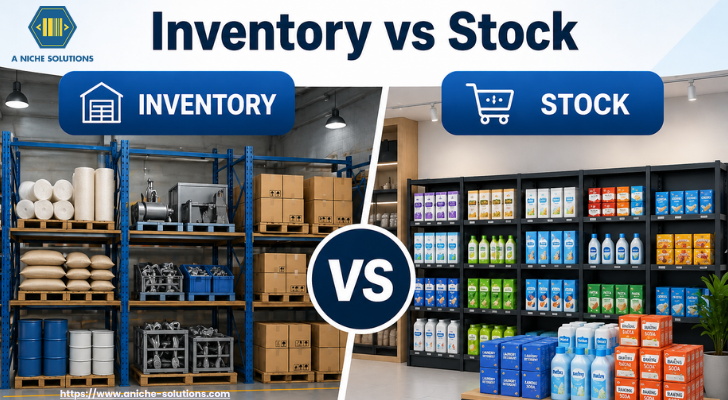
Many people think inventory vs stock means the same thing, but there is a small difference. In business, both terms are used daily, especially in retail, manufacturing, and logistics. Still, they are not exactly equal.
Stock usually refers to finished goods that are ready to sell to customers. Inventory is a broader term. It includes stock, raw materials, and items used in production. Because of this, confusion often happens between stock vs inventory.
Understanding this difference is important for better planning and control. It helps businesses avoid shortages, reduce waste, and manage costs properly. When you clearly know the meaning of inventory vs stock, decision-making becomes easier.
What is Inventory?
Inventory means all the items a business keeps to run its operations. It is not just about finished products. It also includes raw materials, semi-finished goods, and items used during production.
In simple words, inventory covers everything a company owns that helps in making or selling products. This is why in the comparison of inventory vs stock, inventory is always the wider term.
For example, a furniture company keeps wood, nails, tools, and ready chairs. All these items together are called inventory. Each part plays a role in the final product.
Good inventory control helps a business stay prepared. It ensures materials are available when needed and reduces delays in work.
What is Stock?
Stock refers to finished goods that are ready to sell to customers. These are the final products that a business keeps for sale in stores or warehouses.
In simple terms, stock is a part of inventory. This is why in the comparison of stock vs inventory, stock is more specific. It does not include raw materials or work-in-progress items.
For example, in a clothing store, shirts, jeans, and jackets available for customers are called stock. These items are ready for sale and generate revenue for the business.
Stock plays a key role in meeting customer demand. If stock is not managed properly, businesses may face issues like overstocking or running out of products.
4 Key Types of Inventory
Inventory is divided into different types based on how items are used in a business. This helps in better planning and control. It also makes the concept of inventory vs stock more clear.
1. Raw Materials
Raw materials are the basic inputs used to make products. These items are not ready for sale. They are the starting point of production. For example, a furniture business uses wood and nails, while a garment business uses fabric and thread.
2. Work-in-Progress (WIP)
Work-in-progress includes items that are under production. These goods are not complete yet. They are at different stages of the manufacturing process. For example, a half-made chair or a stitched shirt that still needs finishing.
3. Finished Goods
Finished goods are fully completed products. These items are ready to be sold to customers. In simple terms, this is what we call stock. This is where the difference between stock vs inventory becomes easy to understand, since stock is only one part of total inventory.
4. Maintenance, Repair, and Operations (MRO)
MRO items support daily business activities. These are not part of the final product but are still important. Examples include machine tools, safety equipment, cleaning supplies, and spare parts.
Inventory vs Stock: Key Differences
Many people get confused between inventory vs stock, but the difference becomes clear when you look at it in detail. Both are connected, but their role in a business is not the same.
Simple Explanation
Inventory is the bigger picture. It includes everything a business needs to run operations. Stock is just one part of it, which is ready for customers.
For example, in a mobile manufacturing company, parts like screens, batteries, and chips are inventory. Once the phone is fully made and packed, it becomes stock. This is the main idea behind stock vs inventory.
Why This Difference Matters
Clear understanding helps in better planning. It avoids confusion in reports and daily operations. Businesses can manage materials, production, and sales more smoothly. It also improves decision-making in purchasing and storage.
Examples of Inventory and stock
Understanding examples makes inventory and stock easier to understand. Both are related, but their usage is different in real business situations.
Examples of Inventory
Manufacturing Example - A car manufacturing company keeps raw materials like steel, rubber, and engine parts. These items are used to build the final product, so they are part of inventory. Cars that are still being assembled also come under inventory because they are not ready yet. Even items like machine oil, tools, and spare parts are included since they support the production process.
Retail Business Example - A supermarket stores many items in its warehouse before placing them on shelves. These stored goods are part of inventory. Along with that, packaging materials, billing paper rolls, and storage supplies are also counted as inventory because they help in daily operations.
Food Industry Example - A restaurant keeps ingredients like vegetables, oil, and spices. These are part of inventory as they are used to prepare food. Meals being cooked in the kitchen are also inventory under work-in-progress. Kitchen equipment and gas cylinders are included too because they are needed to run the business.
Examples of Stock
Clothing Store Example - A clothing store displays shirts, jeans, and jackets for customers. These items are fully ready to sell, so they are called stock. They are final products and directly generate revenue for the business.
Electronics Shop Example - An electronics shop keeps mobile phones, laptops, and accessories ready for sale. These products are packed and priced, which makes them stock. Customers can buy them without any further process.
Pharmacy Example - A pharmacy keeps medicines arranged on shelves. These medicines are ready for customers to purchase, so they are stock. Each item is a finished product with a fixed use and price.
Key Differences Between Inventory Management vs Stock Management
Understanding the difference between inventory management vs stock management helps in better planning, cost control, and avoiding shortages or excess items.
Meaning
Inventory management deals with everything a business uses to run its operations. It includes raw materials, items under production, finished goods, and even support items like tools and spare parts. Stock management is more specific. It only handles finished goods that are ready to sell to customers.
Scope
Inventory management has a wide scope because it starts from purchasing raw materials and continues till the final product is ready. It covers storage, usage, and movement of all items. Stock management has a narrow scope as it only focuses on storing and selling finished products.
Focus Area
Inventory management focuses on keeping the entire process running smoothly. It ensures that materials are available when needed so production does not stop. Stock management focuses on keeping the right number of products ready for customers. It helps in meeting demand without delays.
Process Involved
Inventory management includes multiple steps like purchasing raw materials, tracking their usage, managing production stages, and storing goods properly. It also involves checking stock levels at different stages. Stock management mainly involves tracking available products, updating stock levels, and refilling items when needed.
Objective
The main goal of inventory management is to avoid production delays and reduce waste. It helps in maintaining a proper balance of materials. Stock management aims to make sure products are always available for sale. It also helps in avoiding excess stock or empty shelves.
Usage in Business
Inventory management is mostly used in manufacturing units, warehouses, and supply chain operations where multiple stages are involved. Stock management is commonly used in retail stores, supermarkets, and eCommerce businesses where the main focus is selling products.
Complexity
Inventory management is more complex because it handles different types of items at different stages. It requires proper planning and tracking systems. Stock management is simpler in comparison because it deals only with finished goods and their availability.
Cost Impact
Inventory management has a direct impact on production cost. Poor handling can lead to waste, delays, or extra storage costs. Stock management affects sales and revenue. If stock is not managed well, businesses may lose customers due to unavailability or face losses due to unsold products.
Control and Tracking
Inventory management needs detailed tracking systems to monitor materials at every stage. Businesses often use software to manage this process. Stock management also needs tracking, but it is usually focused on counting available products and updating sales data.
Tips for Managing Inventory and Stock Efficiently
Managing inventory and stock properly helps a business avoid losses and run operations smoothly. It also improves planning and keeps customers satisfied. Below are five important tips explained in detail.
Track Inventory Regularly
Keeping a proper record of all items is very important. Businesses should track raw materials, work-in-progress items, and finished goods on a regular basis. This helps in knowing the exact quantity available at any time. When records are updated, it becomes easier to plan purchases and avoid shortages or excess stock. Regular tracking also reduces errors and confusion in daily operations.
Use Inventory Management Software
Handling everything manually can lead to mistakes. Inventory management software makes the process simple and accurate. It provides real-time updates, so businesses always know their stock levels. It also helps in generating reports, tracking movement of goods, and improving decision-making. With the help of software, managing inventory management vs stock management becomes more organized.
Maintain the Right Stock Levels
Keeping too much stock increases storage costs and may lead to damage or expiry. On the other hand, low stock can result in lost sales and unhappy customers. Businesses should always maintain a balance based on demand. This can be done by studying past sales data and planning accordingly. Maintaining the right level helps in better control of stock vs inventory.
Conduct Regular Audits
Regular checking of inventory and stock helps in identifying mistakes early. Audits can show if there are missing items, damaged goods, or incorrect records. This keeps the system accurate and reliable. It also builds better control over business operations and prevents financial loss.
Improve Storage and Organization
Proper storage makes a big difference in managing inventory and stock. Items should be arranged in a systematic way with clear labels. This helps workers find products quickly and reduces time waste. Good storage also prevents damage and keeps goods in good condition. Organized storage leads to smoother operations and better efficiency.
Optimize Your Stock Inventory Control with the A’Niche Solution
Managing inventory and stock manually can slow down operations and increase errors. A smart system helps businesses stay organized and maintain better control over their goods. This is where A’Niche Solution plays an important role.
A’Niche Solution provides an advanced inventory management system that helps track items at every stage. It gives real-time visibility of stock levels, so businesses always know what is available and what needs to be restocked. This reduces the chances of overstocking or running out of products.
The system also supports barcode-based tracking, which improves accuracy and speeds up operations. Businesses can easily monitor the movement of goods, from receiving raw materials to delivering finished products.
A’Niche Solution also helps in generating detailed reports. These reports give clear insights into stock usage, demand patterns, and storage needs. With better data, businesses can make smarter decisions and improve overall efficiency.
FAQ
1. Is stock a part of inventory?
Yes, stock is a part of inventory. Inventory is a broader term, and stock is one category within it, which includes only sale-ready goods.
2. Why is inventory management important?
Inventory management helps businesses keep the right amount of materials and products. It reduces waste, avoids delays, and ensures smooth operations.
3. What happens if stock is not managed properly?
Poor stock management can lead to overstocking or shortage of products. This may result in increased storage costs or loss of sales opportunities.
4. Can a business have inventory without stock?
Yes, a business can have inventory without stock, especially during production stages. For example, raw materials and work-in-progress items are inventory but not stock.
5. Why is tracking both inventory and stock important?
Tracking both helps businesses maintain balance in operations. It ensures production runs smoothly and customers always get products on time.
Conclusion
Understanding inventory vs stock is important for every business that deals with products. Inventory includes all items used in operations like raw materials, work-in-progress, and finished goods. Stock, on the other hand, only refers to finished products that are ready for sale.
When businesses clearly understand the difference between stock vs inventory, it becomes easier to plan production, manage storage, and meet customer demand. It also helps in reducing waste, avoiding shortages, and improving overall efficiency.